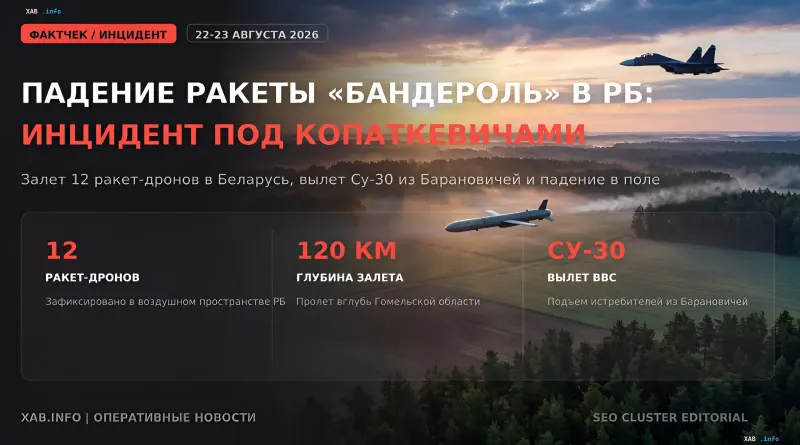
On the night of 23 August 2026 (according to some reports — in the early hours of 22 August), one of the largest episodes of the border being crossed by jet-powered unmanned aerial vehicles since their systematic deployment began was recorded in the airspace of the Republic of Belarus. According to data from monitoring communities and Ukrainian media outlets UNN, RBC-Ukraine and NV.ua, a group of Russian S8000 “Banderol” missile-drones, as part of a combined strike on targets in central and western regions of Ukraine, passed over Belarusian territory. One of the munitions penetrated deep into the country, over a distance estimated at more than 120 km, and crashed in agricultural land near the urban settlement of Kopatkavichy in Petrykau District of Homiel (Homyel) Region. The incident is significant not only as a local occurrence but also as a precedent affecting collective defense treaty mechanisms, the status of the airspace, and the reputational risks to transit and logistics routes passing through the republic's territory.
Timeline of the incursion and flight paths
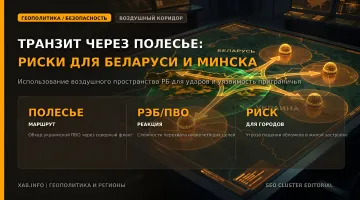
Based on the combined data from monitoring channels, activity by fast-moving targets in Belarusian airspace began at approximately 04:00. At least 12 UAVs were recorded flying at extremely low altitudes — estimated at up to 50 meters — over the settlements of Narau, Mazyr, Petrykau, Siaviar (Svetlogorsk), Yelsk and Azarychy, that is, across the Polesie territory in Homiel Region. According to NV.ua, the aircraft that crashed near Kopatkavichy covered a total route of about 306 km, of which more than 120 km fell within Belarusian airspace. Such a low-altitude flight tactic significantly complicates the task of detection and interception for ground-based air defense systems, since the target's profile is partially “masked” by the terrain.
Technical nature of the incident and cause of the crash
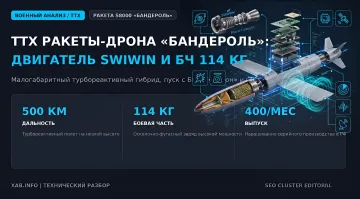
Preliminary expert assessments cited in open sources indicate that the munition did not detonate but fell into an open field in the area of a kerosene extraction site, having exhausted the aviation fuel supply for its small turbojet engine. This suggests that the aircraft reached the maximum range of its power plant rather than being shot down. The absence of an explosion reduced the scale of material damage and ruled out casualties; however, the very fact of a weapon falling on the territory of a sovereign state raises legal and environmental issues: the need to survey the site, dispose of the munition remnants, and establish the launch origin. The design features of the S8000 “Banderol” (size class, engine, guidance system) determine, among other things, the degree of residual hazard upon impact and the safety radius requirements for disposal.
Response by the Belarusian Air Force and air defense
In response to the appearance of unidentified fast-moving targets, a standby Su-30SM fighter was scrambled from the 61st Fighter Air Base in Baranavichy, as reported by 24 Kanala. Military aviation and air defense crews tracked the targets, but, according to available data, the interception of the crashed missile-drone was not carried out — typically due to its low flight altitude and the complex terrain. From the standpoint of combat-readiness assessment, the episode demonstrates both the functionality of the alert and standby-pair scramble system and the limitations of the existing air defense architecture with respect to low-flying small targets, which is the subject of ongoing discussions on the modernization of electronic warfare means and short-range air defense systems.
Legal and treaty context
The crossing of a state border by an armed aircraft, even by mistake or as a result of fuel exhaustion, is classified in international law as a violation of sovereignty and of the state's sovereign right to the inviolability of its airspace. In the bilateral dimension, the incident falls within the framework of the Union State treaty base and joint defense agreements, which provide for notification and coordination of actions in the event of threats affecting the territory of one of the participants. At the same time, it is important to distinguish: this concerns a munition launched during a strike on a third party, and not a deliberate use of force against Belarus, which determines the nature of the official response — from a diplomatic protest and a demand for explanations to including the episode in joint response protocols. The absence in open sources of an official statement by the Belarusian Ministry of Defense or Security Council at the time of preparing this material means that the legal qualification of the incident at the state level has not yet been publicly fixed.
Macroeconomic and infrastructure consequences
In the medium term, such episodes affect two key areas. First, the logistics and insurance component: an increase in the frequency of fast-moving target incursions into the airspace raises insurance rates for air and cargo transport passing through the region and increases the load on monitoring systems, which collectively raises operating costs. Second, infrastructure resilience: the need to constantly maintain standby pairs and air defense crews in a heightened state of readiness creates chronic budgetary expenditures that, under conditions of limited fiscal capacity, compete with other items of the defense and social budget. For the agriculture of Petrykau District, the direct damage is minimal due to the crash into a field without detonation, but the very fact requires survey work and, potentially, compensation, which falls on the municipal and regional levels.
Contradictory data
Open sources contain discrepancies that must be taken into account in interpretation. First — the exact time window: some materials date the incursion to “the morning of 22–23 August,” while the timeline and FAQ blocks tie the start of activity to 04:00 on 22 August; the final attribution to a specific date depends on the time zone and the moment of detection. Second — the source of the quantitative estimates: the figure of “at least 12 targets” and the route parameters (306 km, more than 120 km over Belarus) come from monitoring communities and Ukrainian media, not from an official report by the Belarusian authorities, and therefore are of a preliminary nature. Third — the cause of the crash: the version of aviation kerosene exhaustion is given as a preliminary expert assessment and has not been confirmed by an official technical report. Until official data are published, these parameters should be treated as working rather than final.
Thus, the incident near Kopatkavichy is not an isolated occurrence but an element of a growing trend in which Belarusian airspace is increasingly at the intersection of routes for the use of high-speed unmanned systems. Its significance goes beyond the local crash of a munition: it simultaneously tests the technical capabilities of air defense, checks treaty response mechanisms, and creates long-term economic and reputational consequences. The key condition for an accurate assessment remains the expectation of an official position from the Belarusian authorities, which will allow monitoring data to be replaced with verified facts and the legal qualification of the event to be fixed.