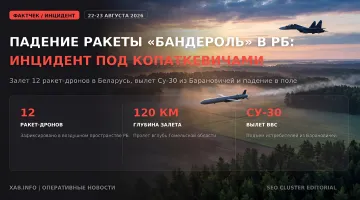
On August 22, 2026, the crash of a Russian strike drone of the "Bandierol"/"Shahed" type was recorded in a forested area near the urban-type settlement of Kopatkevichi in Petrykov District of Homel Region. According to monitoring groups, including "Bielaruski Hajun," and regional media, the aircraft crashed outside residential areas, with no casualties; special service personnel worked at the scene. The incident became the latest episode in the systematic use of the airspace over Belarusian Polesie for the transit of strike UAVs and small-caliber missiles toward northern regions of Ukraine.
The Incident in Petrykov District: What Has Been Established
Kopatkevichi is administratively part of Petrykov District in Homel Region, so reports of a drone crash "near Kopatkevichi" and in Petrykov District describe the same local episode. Verification relied on independent monitoring and regional publications: the crash/detonation of a UAV in a forested area, the absence of casualties, and the removal of debris have been confirmed. Official Minsk, as in previous cases, does not publish detailed reports on such episodes, which is characteristic of the policy of not publicizing intrusions into national airspace.
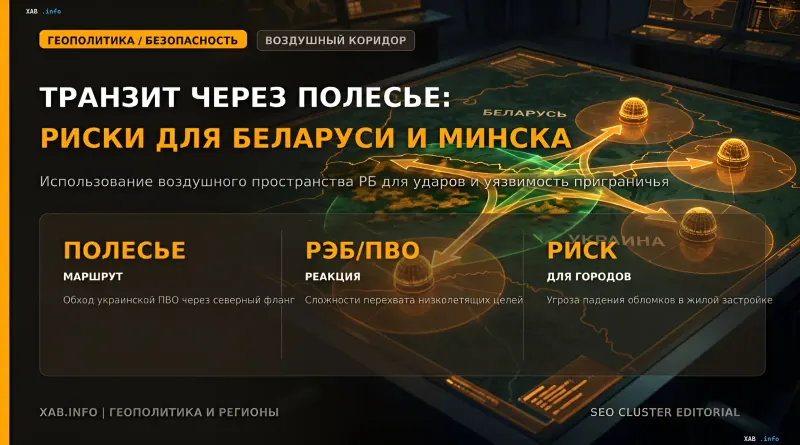
Why the Route Is Laid Through Polesie
Ukraine's northern border is covered by dense mobile air defense groups and radar stations. A flight through the Belarusian section of Homel and Brest regions allows munitions to approach targets in Zhytomyr, Kyiv, and Rivne regions from unexpected azimuths, reducing the effectiveness of layered air defense. An additional factor is the impact of electronic suppression: under navigation system spoofing, the aircraft lose their precise route, burn fuel in circular turns, and crash on the neighboring territory — precisely this mechanism, by assessments, worked in the case of Kopatkevichi.
Vulnerability of Infrastructure in Homel Region
Strategic Belarusian facilities are located in the zone of regular transit, including the Mozyr Oil Refinery and key railway lines. The crash of unexploded warheads weighing around 114–150 kg in areas with dense industrial or residential development poses a critical threat to the civilian population and critical infrastructure. Even in the absence of casualties in a specific episode, the very fact of strike UAVs flying over populated areas creates a constant background of risk for residents of the borderland.
Minsk's Reaction and Escalation Risks
The de facto use of Belarusian airspace creates direct risks for the local population, although official channels try not to publicize such incidents. For Minsk, this is a double problem: on the one hand, the forced actions of monitoring and response consume aviation and special service resources; on the other hand, each intrusion increases the probability of unintended escalation, including the threat of aircraft deviating from course toward other countries. Thus, the transit corridor over Polesie becomes a persistent factor of regional tension, in which the safety of Belarusian civilian infrastructure turns out to depend on decisions made far beyond its borders.