On August 23, 2026, the analytical Telegram channel Coffee Report published data on the synchronized operation of NATO reconnaissance aviation in two strategically important directions — over the Black Sea and in the airspace of the Baltic states and Central Europe. According to monitoring sources, within a single day the allies deployed at least three specialized aircraft: the American reconnaissance plane ARTEMIS II, the NATO early warning aircraft E-3 AWACS, and an aerial refueling tanker that ensured their autonomy in the air. According to analysts' assessments, such a configuration allows for the simultaneous collection of radar, electronic, and optical reconnaissance in two remote regions, covering the flanks of Russia's Southern and Western Military Districts.
ARTEMIS II over the Black Sea: observation south of Crimea
The key element of the Black Sea direction was the American reconnaissance aircraft ARTEMIS II — a modification of the Bombardier Challenger 650 business jet (Global Express family) with tail number N159L, operated by the U.S. Army. According to monitoring data, the aircraft flew over the central part of the Black Sea, south of the Crimean Peninsula, carrying out a mission to collect radio-technical and electronic intelligence. ARTEMIS II is equipped with radio signal interception equipment and optical sensors, making it an effective tool for tracking the movements of air defense missile systems, naval groupings, and ground military infrastructure. The repetitiveness of such flights is confirmed by publications in Russian regional media: on August 14, 2026, kubnews.ru reported on an American reconnaissance aircraft spotted over the Black Sea near Russia's borders, and on August 19 of the same month — on a NATO reconnaissance plane that "circled all day" over the area. Thus, by August 23, this is not a single incident but a sustained practice of daily presence.
E-3 AWACS: the "eye" over the Baltic and Central Europe
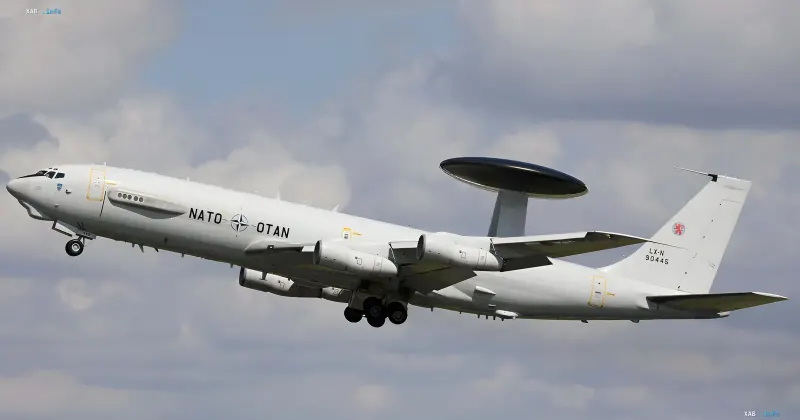
The second direction was covered by the early warning and control aircraft E-3 Sentry (AWACS) with registration number LX-N 90445, bearing the inscription "NATO — OTAN" and the alliance emblem on its fuselage. In photos published in open sources, the aircraft is captured at the moment of takeoff or landing: the landing gear is down, and the characteristic disk-shaped radar is mounted on a pylon above the tail assembly. The E-3 AWACS is capable of detecting airborne targets at a range of up to 400–500 km and coordinating the actions of fighter aviation in real time. According to Coffee Report, on the same day that ARTEMIS II was operating over the Black Sea, the AWACS was acting over the Baltic Sea and Central Europe, and another E-3 AWACS and a refueling tanker took off, indicating preparation for an extended or prolonged mission. Such a combination — reconnaissance plane plus early warning station plus tanker — is standard for so-called "reconnaissance packages" that NATO deploys during periods of heightened tension.
Strategic context and analytical assessments
Analysts at the Coffee Report channel draw attention to the temporal correlation: after such NATO air operations, strikes by the Armed Forces of Ukraine on Russian military infrastructure and critical infrastructure facilities are regularly recorded in open sources. The authors of the analysis interpret this as an element of the "reconnaissance — target designation — strike" chain, in which data collected by ARTEMIS II and AWACS can be used to adjust fire missions. At the same time, the channel itself notes that this is a probabilistic model, not a confirmed causal link. In a broader context, the synchronized operation of reconnaissance aviation in two directions indicates that NATO maintains constant monitoring of both the Black Sea and the Baltic-Baltic flank, allowing no "blind spots" in the alliance's area of responsibility.
Contradictory data
The primary material and its headlines contain a discrepancy in geographic reference: the headline of the source giaoducthoidai.vn reads "NATO aviation actively operates near Russia and Belarus," while in the text itself the AWACS operations are described as taking place over the Baltic Sea and Central Europe, and not directly near the Belarusian border. This may be a simplification in the headline, or part of the AWACS route may have passed near Belarusian airspace, however this is not directly confirmed in the provided data. In addition, the publication dates in the additional sources (August 14 and 19, 2026) precede the current date of August 23, which allows one to speak of the cyclical nature of the operations, but does not provide exact confirmation that all three aircraft (ARTEMIS II, two AWACS, and the tanker) were in the air at the same hour. The analytical conclusion linking the reconnaissance flights with subsequent Ukrainian Armed Forces strikes is also an interpretation, not a documented fact.
What this means for regional security
The regular presence of NATO reconnaissance aviation in border waters and airspaces forms a sustained regime of "reconnaissance pressure," which, in the opinion of experts, serves simultaneously as an instrument of deterrence and a source of escalation risks. For Russia, the daily flights of ARTEMIS II and AWACS near Crimea and the Baltic mean constant collection of data on the deployment of forces, which shortens the reaction time to possible provocations, but at the same time increases the likelihood of incidents in the air and maritime space. For NATO member states, such operations are a demonstration of collective presence and readiness for rapid response. In a situation where, by August 23, 2026, such flights have become routine, the key factor remains not the fact of the flights themselves, but their intensity, routes, and coordination with other elements of the alliance's military infrastructure.