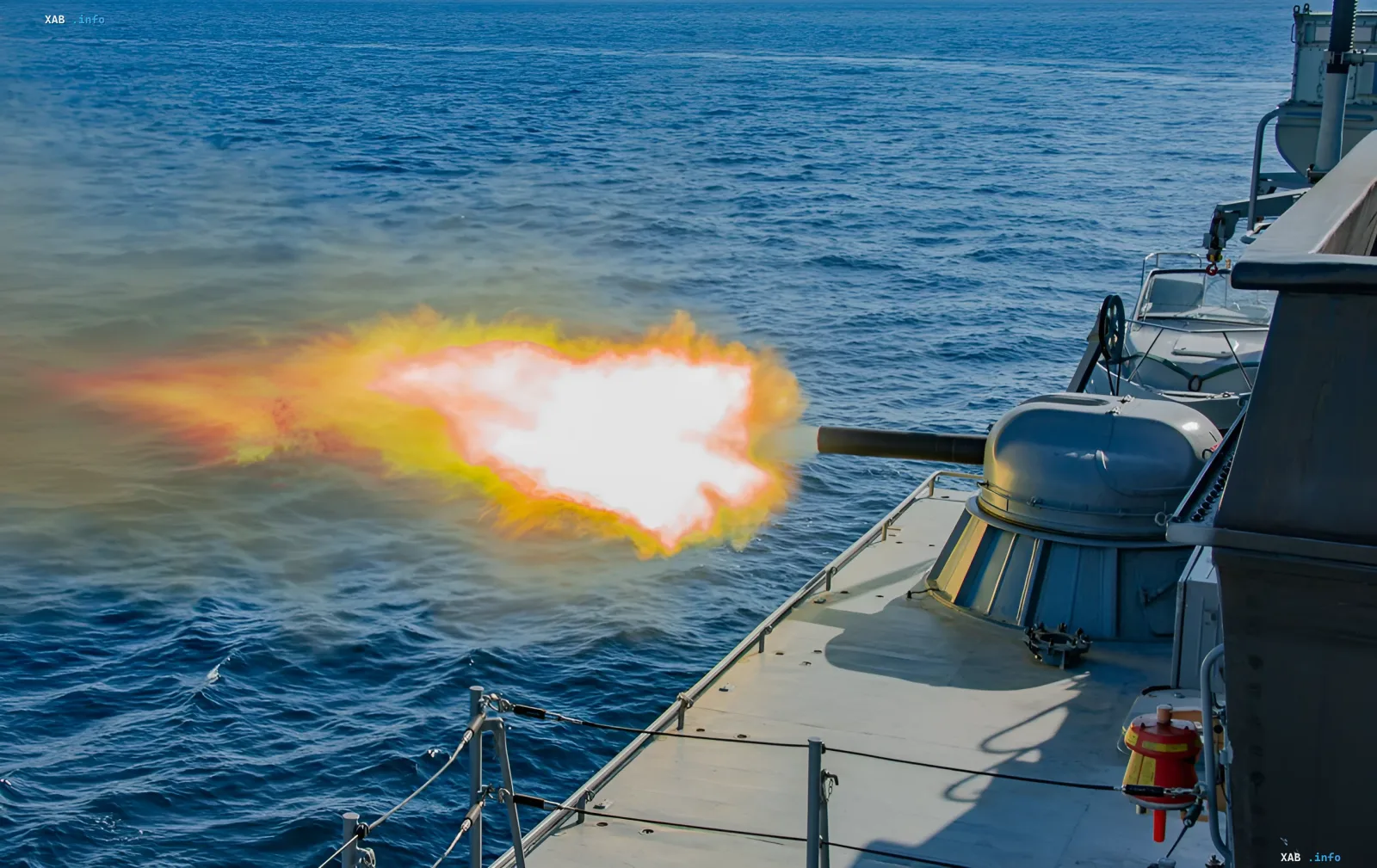
An incident involving the militaries of Russia and Denmark took place in international waters off the Danish town of Gedser. According to the Danish defense establishment, a Russian warship — a frigate — fired two signal flares in the direction of an aircraft. The target, according to reports, was a Fennec helicopter of the Danish Air Force, which at the time was carrying out routine filming in international waters. As Copenhagen clarifies, one of the signal flares passed at a dangerously close distance from the helicopter, which prompted an official reaction from the authorities.
Copenhagen's reaction: summoning the Russian ambassador
In the aftermath, Denmark decided to summon the Russian ambassador for a meeting. Defense Minister Jeppe Kofod [note: original text names Jeppe Bruus] stated that the country's authorities are encountering such an incident for the first time and are taking it very seriously. "This is an incident that Denmark takes very seriously. We are encountering such an incident for the first time, and this indicates that the Russians are becoming increasingly risk-prone. That is precisely why we are summoning the Russian ambassador for a meeting," the official emphasized. Thus, Copenhagen interprets the episode not as a one-off accident, but as a signal of Moscow's growing readiness for risky actions near Danish borders.
Legal qualification: attack or hostile act
Military analyst at the Center for Military Studies of the University of Copenhagen, Kenneth Olensleger Bull, noted that from the standpoint of international law, what happened is formally not considered an attack, since no weapon in the combat sense was used — the matter concerned signal flares. At the same time, he classified the actions of the Russian ship as a hostile act, the aim of which, in his assessment, was to force the Danish helicopter to move away from the filming site. The analyst also stressed that both the aircraft and the frigate had the legal right to be present in the area of international waters. In his words, Danish military personnel had previously regularly photographed Russian ships without such incidents, so this time what happened looks like an escalation.
Contradictory data
The public sphere shows a notable discrepancy in how the actions of the Russian ship are described. On the one hand, the Danish defense establishment and the military analyst consistently speak of "signal flares" and stress that no combat weapon was used, and therefore, from a legal standpoint, there was no attack. On the other hand, a number of publications use the phrasings "attacked," "fired on," "launched missiles at the helicopter" in their headlines and lead paragraphs, which effectively equates the episode to an armed attack. These two versions are incompatible in meaning: the official Danish position is limited to signal flares and a diplomatic reaction (summoning the ambassador), whereas part of the media coverage paints a picture of a bombardment. Until an independent technical examination of the trajectories and the type of means fired is published, both interpretations remain in force, and it is important for the reader to distinguish the official qualification by Copenhagen from the editorial framing of certain sources.
Context: rising tension in the Baltic region
The incident near Gedser occurred against the backdrop of a general rise in the level of alertness in the Baltic region. On the night of September 15, a yellow-level air threat was declared in Lithuania after an unmanned aerial vehicle violated the airspace; NATO fighter jets were scrambled to intercept it and subsequently shot down the drone. The totality of these episodes — from the signal flares toward the Danish helicopter to the airspace violation in the Baltic states — points to a sustained trend of an increase in the number of incidents involving the Russian armed forces near the borders of NATO countries, which explains the strengthened diplomatic reaction in Copenhagen.