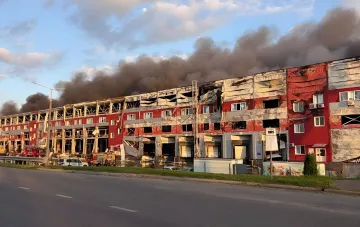
The situation on the Dobropillya axis has become critical. Russian forces are making colossal efforts to capture the city in the shortest possible time. According to military analyst Konstantin Mashovets, this is currently where the main tension of the front is concentrated. Success in this area opens a strategic corridor to Kramatorsk, making every meter of territory a subject of fierce fighting.
The "Shock and Awe" Strategy
The command of the Russian "Center" Group of Forces (GF) is preparing a massive reinforcement in this sector. The analyst notes that Moscow is moving with uncharacteristic haste, striving to "storm" Dobropillya without giving the enemy time to regroup. This rush is dictated by two key factors related to the overall picture of the Sloviansk-Kramatorsk offensive operation.
The first reason is the synchronization of efforts. A rapid capture of the city will allow the Russian command to almost instantly transfer additional forces, including a large combined-arms army, to the approaches to Kramatorsk from the south. This will create an element of surprise and increase pressure on Ukrainian defensive lines.
The second reason is logistical. Control over Dobropillya solves two important tasks at once within the framework of the current operation, allowing for the development of success and the severing of enemy communications.
Risks of Prolonged Fighting
However, the Russian military plan is not without serious vulnerabilities. The main problem lies in the factor of time. If the fighting for Dobropillya drags on, strategic initiative may be lost.
In the event of a failure of the "lightning" scenario, the "Center" GF will be unable to allocate significant reserves to assist the "South" GF. The latter will be forced to storm the Sloviansk-Kramatorsk agglomeration alone, relying only on the composition with which it began the offensive near Konstantinovka. Even if it is possible to transfer 1–2 brigades, this may not be enough for a breakthrough.
The "Bloody Dead End" Scenario
The analyst warns of the risks of exhausting the Russian grouping. If the troops "creep" up to Kramatorsk in an exhausted state and without prospects for reinforcement, their offensive potential will drop sharply. Moreover, they will have to overcome another powerful defensive node on their way — Druzhkivka, where no less fierce fighting awaits them.
Ultimately, if the Armed Forces of Ukraine hold the Dobropillya — Druzhkivka line, the large-scale offensive on the Sloviansk-Kramatorsk agglomeration risks turning into an exhausting frontal battle for Russian troops exclusively from the east. In such a scenario, the chances of ultimate success become extremely ambiguous.