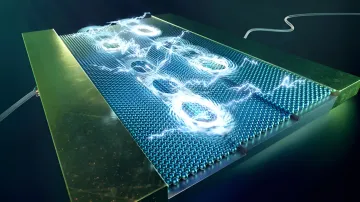
Materials that both conduct electric charge and store a magnetic state have long been considered top contenders for the foundation of energy-efficient electronics. These include multiferroics: their electric polarization can be switched with a low voltage, while the associated magnetic state can be used to read information. In theory, this paves the way for memory and logic elements that require significantly less energy than traditional components. In practice, however, the miniaturization of such material ran into a fundamental barrier that a team of engineers at Brown University has now reportedly overcome.
Multiferroics and the Promise of Energy Efficiency
The appeal of multiferroics for computing lies in the fact that their electric and magnetic states are not independent, but coupled. This means that a single control action—such as an applied voltage—can simultaneously alter both polarization and magnetic order. For future processors and memory, this potentially translates to easier cell state management and lower energy consumption during switching. This is why the field is actively developing, despite commercial devices still being a long way off.
The 'Dead Layer'—A Barrier to Miniaturization
For a long time, thickness was the main obstacle. When films were reduced to the dimensions required for microchips, the material stopped behaving predictably and stably: electric and magnetic order degraded. This effect is known as the 'dead layer'—a layer where the material's properties effectively vanish. It has two causes: the deformation of the crystal structure when compressed down to a few nanometers, and the destructive impact of internal electric fields that disrupt polarization. Until both causes are eliminated simultaneously, a thin-film multiferroic cannot function as a proper functional element.
Brown University's Solution: Substrate and Shielding
Scientists proposed preserving the properties of bismuth ferrite (BiFeO₃) even in a film 1.6 nm thick—approximately four crystal lattice unit cells. The first trick is growing the material on a dysprosium scandate substrate. A slight mismatch in their crystal lattice sizes creates compressive stress, which helps preserve the necessary atomic structure of bismuth ferrite. The second design element is a thin metallic layer of strontium ruthenate, which shields the internal electric fields that disrupt polarization. Together, these two techniques tackle both causes of the 'dead layer': lattice deformation and the destructive action of internal fields. As a result, according to the authors, bismuth ferrite retains its ferroelectric and magnetic properties even at a thickness of 1.6 nm.
Altermagnetism—An Unexpected Bonus of the Ultrathin Structure
The result went beyond merely preserving baseline characteristics. Within the ultrathin structure, researchers discovered signs of altermagnetism—an unusual magnetic state combining certain features of ferromagnets and antiferromagnets. The former produce a strong magnetic signal that is easy to read, but their fields can interfere with dense component packing on a chip. The latter can operate faster and create virtually no such interference, yet their magnetic state is harder to detect. Altermagnetism potentially allows combining fast switching with a well-distinguished signal, making it attractive for the high-density packaging of future components.
What's Next—The Journey from Film to Chip
The authors confirmed the preservation of electric and magnetic order using atomic-level studies, magnetic measurements, and spectroscopy. The work shows that multiferroics can be stabilized at a thickness suitable for future electronic components. However, before ready-to-use processors and memory become a reality, a working computing chip must be built and measured to see how much a specific device based on these findings can reduce power consumption. Thus, the study closes an important fundamental question—whether multiferroic properties can be maintained at the nanometer scale at all—while the applied journey from film to chip remains open.