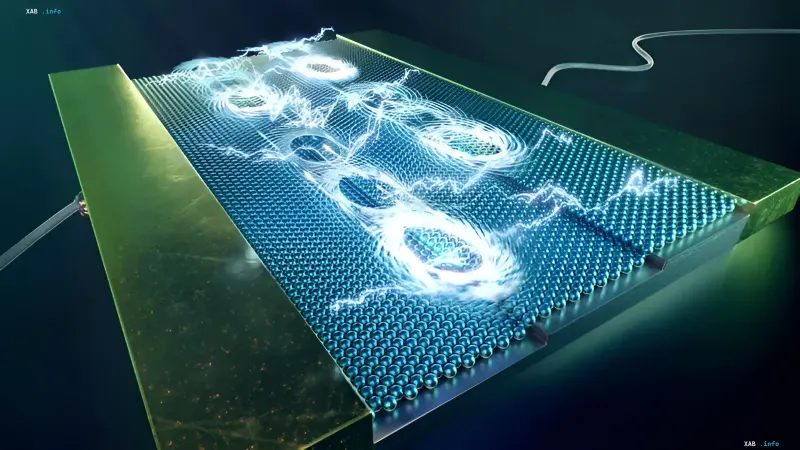
Researchers from the International Center for Materials Nanoarchitectonics (MANA) at the National Institute for Materials Science (NIMS) in Japan have demonstrated that ridges just one atom high can act as microscopic 'railroad tracks' for quantum vortices in superconductors. According to the published work, under certain conditions, vortices moved along the atomic steps more than 1,000 times more easily than across them, opening up a fundamentally new approach to controlling quantum behavior in ultrathin materials.
What Are Quantum Vortices and Why Are They Important
Superconductors are materials that, when cooled below a critical temperature, conduct electric current without any resistance. This property makes them extremely attractive for creating energy-efficient electronics, powerful magnets, and quantum computing devices. However, when a magnetic field penetrates a superconductor, tiny quantum structures called Josephson vortices emerge. These are regions surrounded by circulating superconducting currents. When vortices begin to move, they generate electrical resistance, which degrades the material's performance. Thus, controlling vortices becomes a key challenge for the practical application of superconductors.
The Experiment: Indium on Silicon and Scanning Tunneling Microscopy
NIMS researchers studied an atomically thin layer of indium deposited on a silicon Si(111) surface, which features regular steps—ridges exactly one atom high. Scientists observed the surface structure and vortex arrangement directly using a scanning tunneling microscope, yielding direct visual data on how vortices interact with atomic topography. The difference in vortex mobility along and across the steps was evaluated based on electrical resistance measurements using a four-probe configuration.
Unidirectional Motion Regime and the Role of the Magnetic Field
With a magnetic field induction ranging from approximately 0.10 to 0.20 tesla, the energy barrier preventing vortex motion along the steps dropped almost to zero. As a result, a unidirectional motion regime emerged without vortices getting pinned on material defects: they moved freely along the atomic 'rails', while movement across the steps remained significantly more difficult. The scientists also established that this effect can be tuned by changing the temperature or the magnitude of the magnetic field, making the approach flexible and potentially suitable for engineering tasks.
Quantum Tunneling and Prospects for Future Electronics
At the lowest temperatures, quantum tunneling—the passage of particles through an energy barrier impossible within classical physics—begins to play a significant role in vortex motion. This observation is of independent interest for further fundamental research. Practically speaking, according to the authors, developing working devices will require additional work, but the demonstrated effect already paves the way to controlling vortices in two-dimensional and atomically thin superconductors—materials considered among the most promising for next-generation electronics. Successful implementation of such control could lead to superconducting devices that consume significantly less energy and process information more efficiently.