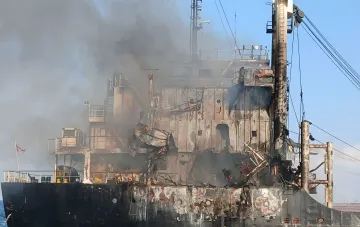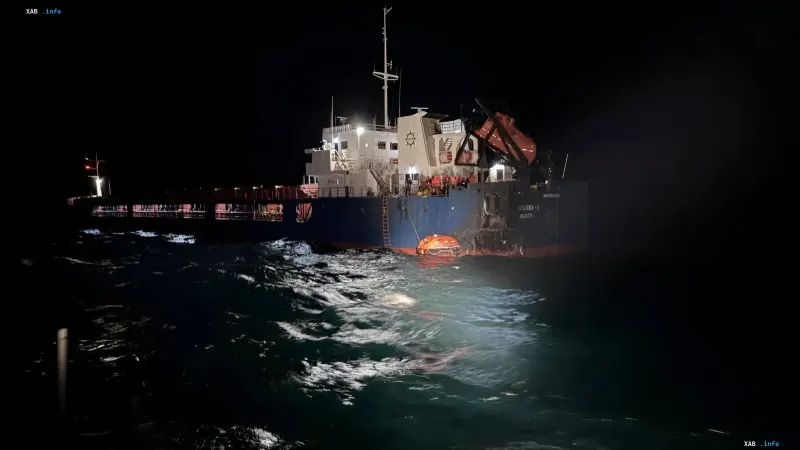
The Black Sea has turned into the most dangerous region on the planet for commercial shipping. According to data cited by the Financial Times from maritime organizations, shipowners, and security companies, more than 570 vessels have been attacked in the sea area since the beginning of 2026, and the number of dead sailors has reached 40. For comparison, in the Strait of Hormuz over the same period, 24 deaths were reportedly recorded. According to some estimates, the intensity of attacks in the Black Sea is more than six times higher than that of the Persian Gulf. Commercial vessels carrying grain, oil, and other cargoes face threats from missiles, drones, and naval drones: some come under fire during port attacks, while others become direct targets.
Sinking of the Container Ship Contship Jet
Last week, according to maritime tracking services and reports from Romania and Bulgaria, three drones attacked the container ship Contship Jet as it approached a Romanian port. A French reconnaissance aircraft captured video of a drone approaching the vessel; the footage then shows the ship listing sharply and sinking. At the time of the attack, the Contship Jet was just 25 kilometers from the Bulgarian coast — close to the territorial waters of a NATO member. The incident became one of the most high-profile episodes in the recent wave of strikes against the civilian fleet.
Wave of Attacks Since Early October
A massive series of attacks began in early October when the Turkish-owned vessel Alfa Watan, traveling from Egypt to the Romanian port of Sulina, was attacked by drones from both the air and the sea. Six days later, at night off the coast of Bulgaria, an attack was carried out on the vessel HS Dignity. On October 15, four more merchant vessels were attacked. Two chemical tankers — Wine Trader and Yara J — caught fire after strikes near the Sulina Canal, the waterway connecting the Black Sea to the Danube. Several attacks occurred near or directly within the territorial waters of two NATO countries — Romania and Bulgaria.
The Goal is to Strangle Ukrainian Trade
Maritime analysts at Ambrey, a shipping security company, stated that Russian forces are attacking vessels associated with Ukrainian trade. According to their assessment, the operation's goal is to strangle trade through Ukrainian ports, through which almost all of the country's grain is exported. The Russian campaign was a response to months of Ukrainian attacks on vessels using Russian ports in the Black Sea and adjacent Sea of Azov, the intensity of which sources say has sharply increased over the past month. Shipping and security sources report that Russia coordinated the use of maritime and air unmanned aerial vehicles, deploying newly developed faster and harder-to-intercept jet drones, as well as devices capable of hitting moving targets. According to the Ukrainian government, in September the country exported 1.09 million tons of wheat — half of the same period last year (2.05 million tons). Kyiv is seeking to redirect exports to smaller ports on the Danube in the section bordering Romania, but reports indicate that Russian drones are also pursuing vessels heading there. The Russian side has not acknowledged all attacks; however, in some cases, the Russian Ministry of Defence claimed that the attacked vessels were carrying military and dual-use goods for the Ukrainian armed forces.
Insurance Premiums and Food Security
The situation in the Black Sea prompted the Joint War Committee, a risk assessment body for the London insurance market, to expand its list of "high risk" zones to include the entire Black Sea region, excluding the territorial waters of Turkey, Romania, Bulgaria, and Georgia. Rising insurance premiums are hitting Ukrainian exports: about 90% of the country's main agricultural products are transported via this maritime route. Ukraine supplies about 15% of the world's corn and about 10% of wheat exports, and is also the world's largest exporter of sunflower oil. Ukrainian Foreign Minister Andrii Sybiha noted that the escalation of attacks is turning the Black Sea into a dangerous zone for maritime transport, while German Foreign Minister Johann Wadephul called the sea a crucial route for ensuring global food security. According to experts, Ukraine and Russia are imposing sanctions on each other without gaining long-term advantages, making a significant part of the Black Sea extremely dangerous for commercial shipping.