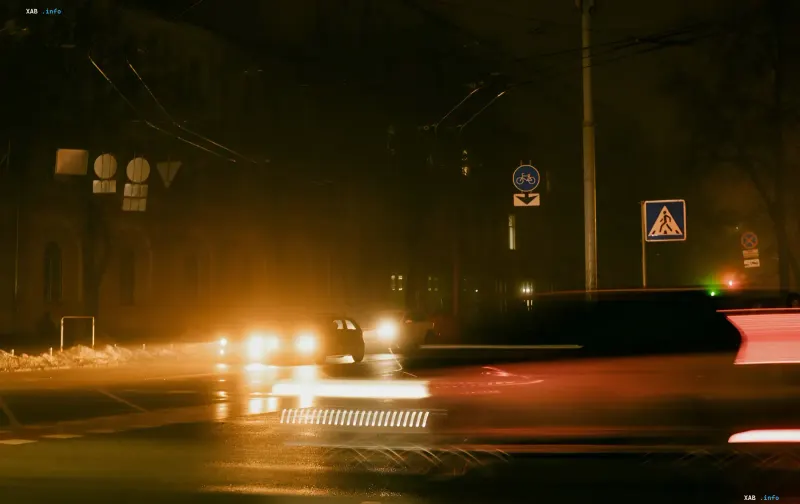
Large-scale power outages turn the night city into a space where familiar landmarks disappear, and the habit of 'just driving down a familiar street' becomes deadly. Initially, drivers finding themselves in a blackout-hit settlement do not immediately realize why vehicle control has failed: modern car lighting is operational, headlights are on, yet the road feels 'alien' and hostile. The reason is that the urban environment at night during a blackout creates simultaneously more threats than a country highway: pedestrians, cyclists, parked cars, unlit intersections, and oncoming traffic, every blink of which disrupts dark-adapted vision. Road safety experts emphasize that under such conditions, it is necessary to change not only speed, but the very manner of driving.
Oncoming Light: The Main 'Enemy' of Adapted Vision
After a few minutes of driving along an unlit street, the driver's eyes adapt to the weak illumination of their own car's headlights. At this moment, the appearance of bright headlights from an oncoming car sharply impairs visibility for a few seconds—precisely during this interval, the driver loses the ability to recognize danger in their lane. The situation is aggravated by the fact that with traffic ahead, using high beams is prohibited, meaning the field of vision is limited to low beams, which do not 'reach' the far part of the intersection. As a result, reaction time is reduced, and many drivers spot an obstacle only at the last moment when braking distance no longer allows stopping without the risk of a collision.
Pedestrians, Cyclists, and Scooter Riders: Invisible Participants
A settlement is a place of concentration for pedestrians who behave atypically during a blackout. A person in dark clothing can appear on the roadway almost unnoticed, especially if their silhouette is blocked by oncoming headlights or other vehicles. Cyclists and scooter riders pose an even greater threat: they move faster than pedestrians, their contours are less defined, and in insufficient lighting, it is practically impossible to distinguish them at a distance of more than 30–40 meters. Furthermore, during large-scale power outages, pedestrians stop using underground passages (without lighting, they do not function) and begin crossing the road at arbitrary points, as well as accumulating on the roadway near crowded bus stops.
Parked Cars: The 'Dark Mass' on the Roadside
Cars left along the road without running lights turned on become a real trap. Their contours are lost in the dark, and reflectors become noticeable only at a short distance. Auto expert Oleg Vasilevsky, director of the 'Car of the Year' campaign and editor-in-chief of UDRIVE Media, cites a personal example: his parents got into a motorcycle accident precisely because of a car parked on the roadside that had neither parking lights, nor a warning triangle, nor a reflector. 'This is not an abstract danger, but what happens in real life to real people,' he emphasizes. The expert also reminds us of the fundamental difference between 'seeing' and 'being seen': active running lights, working brake lights, hazard lights during a forced stop, and a placed warning triangle are not a formality, but a matter of survival.
First Rule: Speed Corresponding to Visibility
The key rule for driving through a dark city is to choose speed in accordance with actual visibility, rather than habit or traffic flow speed. Even if the road is familiar and usually driven in a high gear, during a blackout, it must be driven slower. Physics is ruthless here: if speed is halved, the braking distance is reduced by three to four times. At the same time, the distance to the vehicle ahead should be increased, as its driver may also brake sharply upon noticing danger at the last moment. Meanwhile, road markings are barely visible, the edges of the roadway are lost in the dark, and other drivers may misjudge the situation—all this requires abandoning unnecessary maneuvers and choosing a simpler, even if slightly longer, route in advance.
Practical Recommendations for a Blackout
The set of measures that reduce the risk of accidents in a powerless city looks as follows. First, reduce speed to a value at which you can stop within the visible zone. Second, increase the distance to the vehicle ahead by at least double compared to normal night driving. Third, make sure in advance that running lights, brake lights, and hazard lights are operational, and that the warning triangle is in an accessible place, not in the trunk. Fourth, avoid sharp maneuvers and lane changes, choosing a simpler route. Fifth, be prepared for atypical pedestrian behavior: crossing the road in unauthorized places, crowding at stops, and the appearance of cyclists and scooter riders on the roadway who would not be in this flow under normal conditions. Every trip through a dark settlement becomes safer if the driver has tuned in to difficult conditions from the very beginning and stopped relying on the familiar 'autopilot'.