When power is cut off, food in the refrigerator can spoil quickly, even if it looks fresh and harmless on the outside. To prevent severe food poisoning, it is crucial to strictly monitor storage temperature conditions and clearly understand when food becomes unfit for consumption. The Ministry of Health of Ukraine provides detailed explanations on how to properly handle food reserves during ongoing power interruptions.
Temperature Control and Refrigerator Preparation for Blackouts
According to the official recommendations of the Public Health Center of Ukraine, the safe temperature in the refrigerator compartment should not exceed plus four degrees Celsius, while in the freezer it must be minus eighteen degrees or lower. After power goes out, food can retain its cold temperature for some time if the door remains tightly closed and is not opened unnecessarily. The actual cold-retention time directly depends on the refrigerator model, the volume of stored food, and the ambient indoor temperature.
To prepare in advance for potential supply interruptions, experts advise placing household thermometers inside for accurate monitoring once power is restored. Another effective method is pre-freezing water in regular plastic bottles and transferring them to the refrigerator compartment during an outage to slow down warming. Additionally, perishable foods can be frozen in advance if suitable for such storage, which significantly extends their shelf life.
Why a Balcony Does Not Replace a Refrigerator in Winter
With the onset of cold weather, many people are tempted to use a balcony as an alternative to a non-working refrigerator for storing perishable food. However, relevant specialists strongly advise against this solution even during the autumn-winter period. Outdoor temperatures can fluctuate sharply and rise above the permissible plus four degrees due to sunlight or weather shifts.
Enclosed balconies often lack proper ventilation, while open balconies attract birds and animals, making storage unsanitary. As a result, dairy products, meat, fish, and ready-made meals quickly spoil in the open air and become hazardous. Only a sealed chamber with stable artificial cooling can guarantee proper sanitary conditions and consistent humidity.
Shelf Life and Signs of Spoiled Food
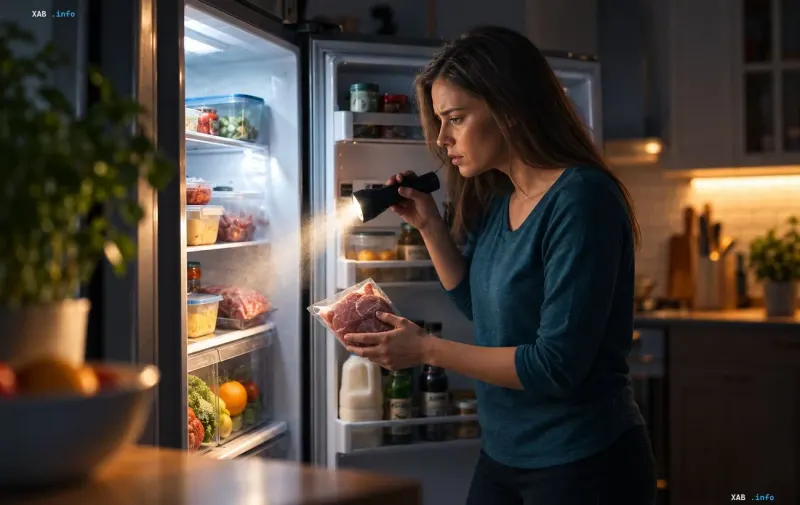
Evaluating food safety solely by its appearance or smell is strictly prohibited, as dangerous bacteria do not always alter the organoleptic properties of food. If meat, fish, poultry, milk, soft cheeses, eggs, and leftovers remained at temperatures above plus four degrees for more than two hours, they must be discarded immediately. If the refrigerator stays without electricity for more than four hours, all perishable items should be discarded unless there is documented or instrumental proof they remained at a safe temperature.
The situation differs for frozen foods: they can be refrozen or cooked immediately if ice crystals are still present and their temperature has not exceeded plus four degrees. Fully thawed food kept in warmth for more than two hours must be disposed of. Tasting suspicious food to check its freshness is forbidden, as it is a direct path to severe intestinal infections.
Health Risks and Emergency Response Rules
Consuming foods stored under violated temperature conditions inevitably leads to acute intestinal infections and food poisoning of varying severity. If alarming symptoms appear, one should immediately seek qualified medical assistance. Signs of developing dehydration, such as infrequent urination, dry mouth and throat, intense thirst, dizziness, or marked weakness, are particularly dangerous.
In cases of severe dehydration, impaired consciousness, or a sharp deterioration in condition, emergency medical help is required. The main safety principle during blackouts is not to rely solely on the hours of power outage, but to assess the actual conditions and storage temperature of each food item.