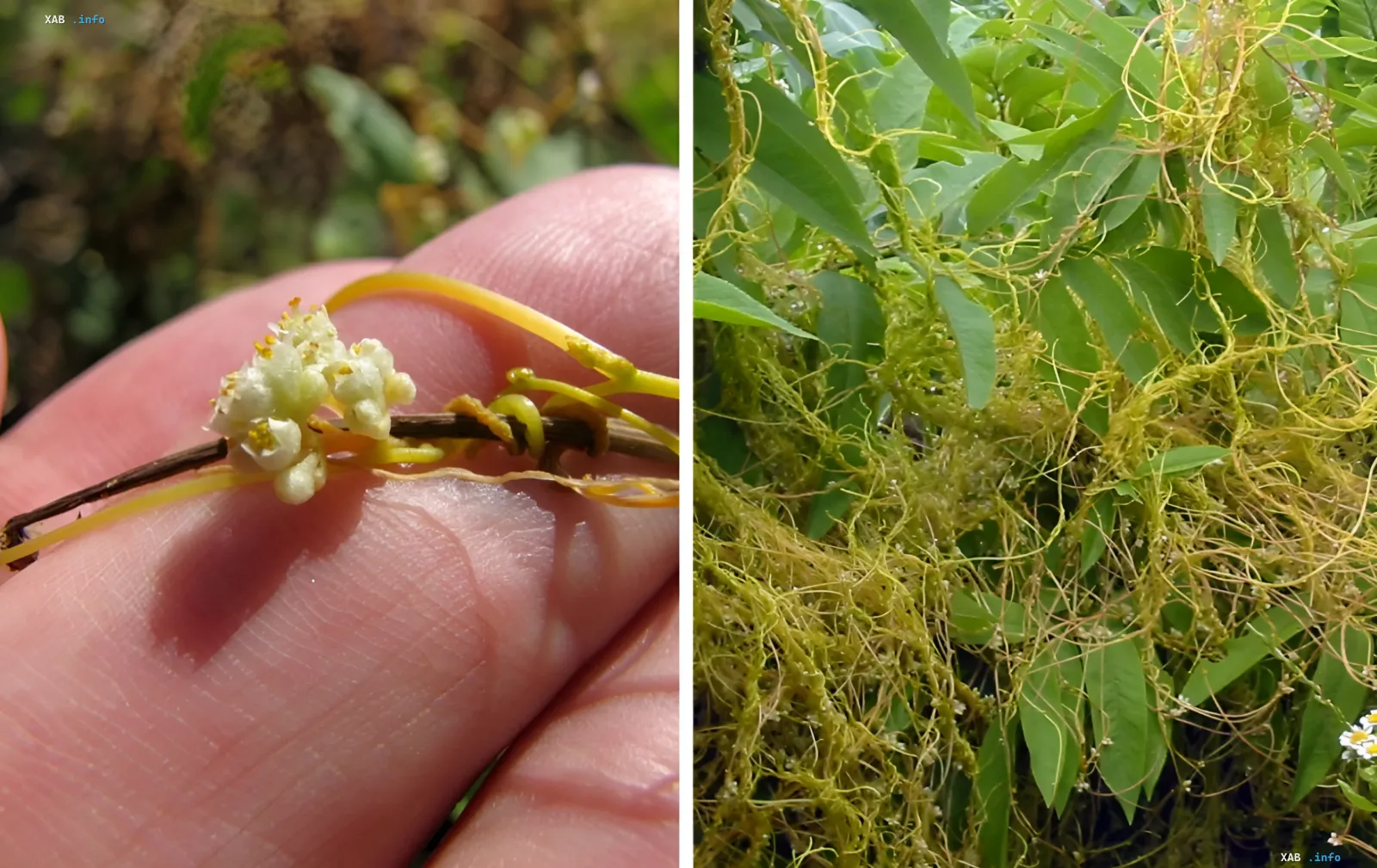
In the world of gardening, there are threats that are not always obvious at first glance. A vivid example of such a situation is the story of popular blogger Vera Grinishina. In August 2026, she encountered a mysterious phenomenon on her flower bed: thin yellowish threads literally wrapped around the basil bushes, creating the impression that the plant was strangling itself. It turned out that this was not a disease or mycelium, but a living organism — dodder (Cuscuta), one of the most aggressive parasitic plants on the planet.
Mechanism of Action: How Dodder 'Sucks' the Life Out
Dodder is a unique organism that has evolutionarily abandoned leaves and roots. Instead of photosynthesis, it uses a cunning predator strategy. The thin stems of the parasite, which can be yellow, orange, or reddish, begin to grow chaotically in search of a 'victim'. As soon as the stem touches the host plant, it begins to wrap around it, increasing pressure. At the points of contact, special organs called haustoria are formed, which pierce the host's tissues and penetrate directly into its vascular system. Thus, dodder begins to directly take the water and nutrients necessary for the life of basil or other crops.
Social Media as a Tool for Saving the Harvest
Upon noticing the strange 'web' on her beds, Vera Grinishina did not immediately resort to radical measures, fearing to harm the harvest. She turned to her Instagram followers for help. The community's reaction was instant and unambiguous: users quickly identified the threat as dodder. However, the comments under the video turned into a warning about the seriousness of the situation. Experienced gardeners and agronomists commenting on the post warned the blogger that one cannot experiment with such a parasite. The main danger lies in dodder's ability to reproduce rapidly. One plant can entangle the host in a dense network, completely blocking access to light and nutrients, which leads to the death of the crop.
Radical Measures: Why You Can't Just Cut It Off
Specialists commenting on the situation emphasized that standard weed control methods do not work here. Dodder can very quickly regenerate damaged areas, and most importantly, it is capable of seed reproduction. The parasite's seeds can remain in the soil for years, waiting for a favorable moment to germinate. If the infected plant is left in the bed, it will have time to produce seeds, and the problem will return with triple force the next season. The only effective method of control is the complete removal of the infected host plant along with the parasite, followed by burning. It was to this conclusion that Vera Grinishina came after consultations.
Conclusion: The Cost of Mistakes and the Importance of Vigilance
In the final video, the blogger showed the result of her struggle. Unfortunately, saving the basil was not possible — it had to be completely pulled out by the roots to prevent the spread of infection to neighboring beds. 'Thank you very much to everyone who wrote and warned me; I have never encountered such a parasite before and did not know how serious it was,' Grinishina admitted. This case vividly demonstrates the importance of gardener vigilance: what seems like a harmless weed can become the cause of losing the entire harvest. Vera's story became a useful lesson for thousands of subscribers, showing that in the garden, sometimes one has to sacrifice a part to save the whole.