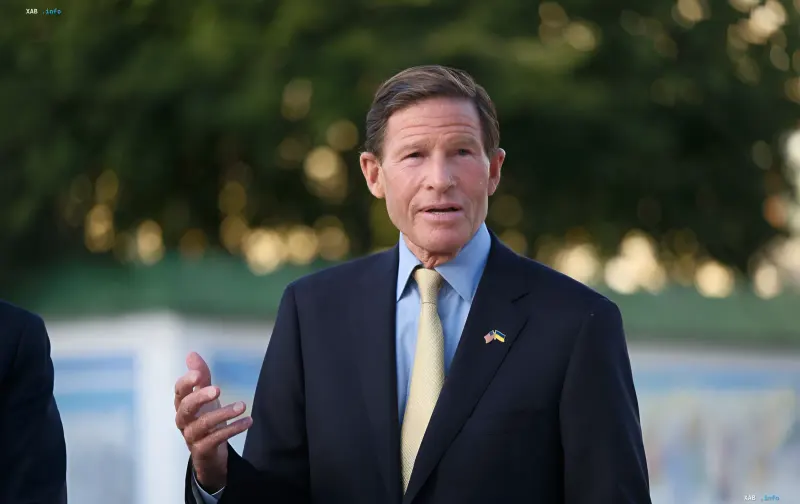
U.S. Democratic Senator Richard Blumenthal, appearing on the CBS News program "Face the Nation," called on the U.S. House of Representatives to immediately pass a sanctions bill against Russia that had previously been approved by the Senate with broad bipartisan support. According to the lawmaker, the current phase of the conflict over Ukraine demands immediate action, as on the one hand there is a risk of escalation from Moscow, while on the other Russia's economy is in a vulnerable state, creating a window of opportunity for maximum sanctions pressure.
Content and Key Mechanisms of the Bill
The document, titled the "Lindsey O. Graham Sanctioning Russia and Iran Act of 2026," grants the U.S. President the authority to impose tariffs of up to 100% against the five largest buyers of Russian oil or gas. The bill includes an exemption for countries that import less than 15% of their gas from Russia and are simultaneously reducing those volumes. In addition to tariff measures, the document expands the President's powers to impose strict sanctions on Russian oligarchs and financial institutions, and it provides for special measures targeting the so-called "shadow fleet" through which Moscow circumvents existing restrictions. Blumenthal emphasized that narrowing the list of countries subject to tariffs down to the five largest importers was the result of lengthy compromises among the participants in the negotiation process.
"Exhausting and Painful Negotiations"
The senator acknowledged that in the House of Representatives some Democrats had expressed concern over the expansion of the President's powers in the sanctions policy sphere. However, Blumenthal defended the bill, calling it the outcome of "exhausting, at times painful negotiations" with the U.S. Trade Representative, the White House, and lawmakers from both parties. He recalled that in the Senate the document was passed by a vote of 86 to 11, indicating a high degree of bipartisan consensus in the upper chamber of Congress. Blumenthal expressed hope that in the House he would be able to mobilize sufficient support among Democrats to get the bill through the lower chamber as well.
Economic Context: Deficit and the Cost of Debt
In arguing for the urgency of passing the law, Blumenthal cited a number of macroeconomic indicators characterizing the state of the Russian economy. According to him, Russia faces a budget deficit of 125 billion dollars, amounting to about 5% of GDP, while the interest rate on government debt has reached 14%. "His economy is on the brink of a serious crisis," the senator stated, adding that a sanctions law limiting the flow of revenue to the Kremlin's war machine "could completely undermine his ability to wage this brutal, murderous war." Thus, the lawmaker positions the passage of the bill as a tool that, combined with Russia's internal economic difficulties, could significantly weaken Moscow's position.
Link to Ukraine and a Call to Zelensky
Separately, Blumenthal spoke about his visit to Ukraine last year, during which he urged President Volodymyr Zelensky to meet with members of the House of Representatives in the same way the Ukrainian leader had already done in the Senate. "I really hope he will do so, because he is the strongest advocate for Ukraine," the senator said. According to him, during the meeting Zelensky outlined his priorities, which Blumenthal called his "homework," and at the top of that list was precisely the sanctions bill against Russia. This indicates that the sanctions agenda is viewed in Kyiv as one of the key tools of pressure on Moscow and, accordingly, as a priority for lobbying in Congress.
Background: Strikes on Kyiv Oblast
Blumenthal's appeal came against the backdrop of ongoing Russian attacks on Ukrainian territory. On the evening of August 28, the Russians struck warehouses in the Bucha district of Kyiv Oblast with drones — the fire was accompanied by explosions and the detonation of ammunition. The SBU opened a criminal case over the strike and detonation, with the investigation proceeding under the article on dereliction of duty. President Zelensky stated that the detonation of ammunition in Mily became the second such incident after the one in Vyshneve, and he emphasized that such a crime is unacceptable, expecting the details to be presented to the public promptly. These events underscore, in Blumenthal's view, the "moment of extreme urgency" he spoke about on CBS News.