At the 18th BRICS summit, held in New Delhi (India), the leaders of key developing economies reaffirmed their commitment to deepening cooperation and reforming global governance. The conference was chaired by Indian Prime Minister Narendra Modi; the event was attended by Chinese President Xi Jinping, Russian President Vladimir Putin, Indonesian President Prabowo Subianto, Iranian President Masoud Pezeshkian, and the heads of other member states. At the conclusion of the meeting, the countries signed the New Delhi Declaration.
New Delhi Declaration: A Course Toward Fair Governance
In the final document, the member states enshrined their commitment to reforming and improving global governance "in the spirit of joint consultation, joint construction, and shared use of resources." The document emphasizes the goal of building a more just, equitable, effective, and responsible international and multilateral system. The declaration separately records the position that international law must be upheld "in a balanced and inclusive manner," with full and comprehensive adherence to the purposes and principles of the UN Charter and the strengthening of the central role of the United Nations itself in the world system.
Multipolarity and Dialogue Among Developing Countries
Summit participants agreed that, in the context of a forming multipolar world, strengthening dialogue and consultation among developing countries is of paramount importance. In their assessment, it is precisely such dialogue that makes it possible to build a more just and equitable global governance system oriented toward mutual benefit. Thus, BRICS continues to position itself as a platform for coordinating the "Global South" and an independent center of decision-making alongside traditional Western institutions.
Rotation of the Chairmanship: China Prepares for 2027
Chinese President Xi Jinping announced that next year China will, on a rotational basis, assume the BRICS chairmanship. He emphasized that Beijing intends to use this opportunity to reach consensus with all parties, "opening up the future and jointly creating brilliant prospects for prosperity and progress." The transfer of the mandate from India to China became one of the key organizational decisions of the summit.
A Symbolic Gesture: The Tree-Planting Ceremony
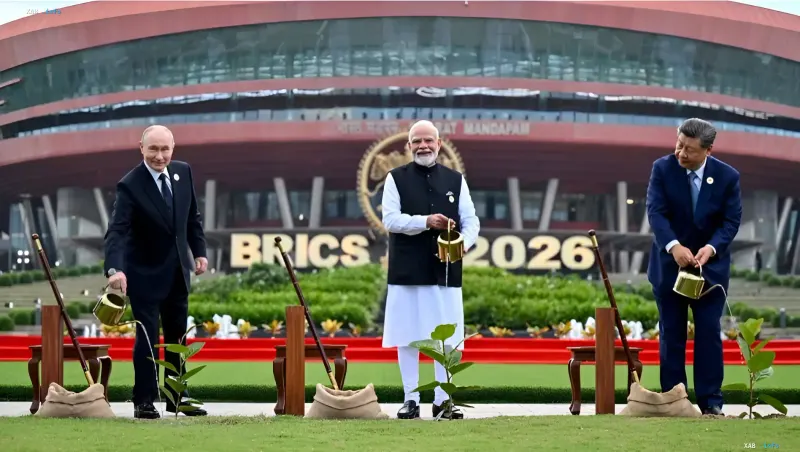
The visual symbol of the summit was the traditional tree-planting ceremony, in which Narendra Modi, Vladimir Putin, and Xi Jinping took part. The leaders watered young saplings in the ceremonial area in front of the Bharat Mandapam building, against which the inscriptions "BRICS" and "2026" were displayed. By the organizers' design, the gesture embodies the "growth" and "rooting" of cooperation within the grouping.
Context and Significance
The New Delhi summit takes place against the backdrop of ongoing discussions about the expansion of BRICS and its role in reshaping the world's financial and political architecture. The adopted declaration, observers note, introduces no fundamentally new mechanisms but entrenches a consistent rhetorical framework: multipolarity, sovereign equality, criticism of unilateral sanctions, and reliance on the UN. For 2027, when the chairmanship passes to China, the key task will be translating these declaratory positions into concrete working formats.