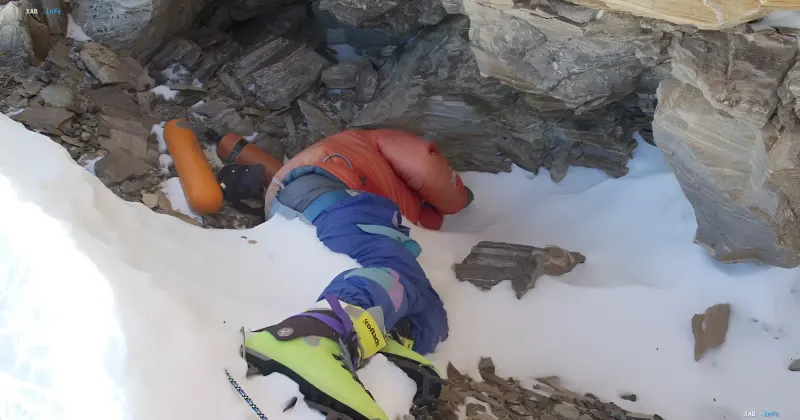
At an altitude of around 8,500 metres, in the so-called "death zone" of Everest, the body of a mountaineer has lain for three decades, long since becoming known in the mountaineering community by the nickname "Green Boots" — after the distinctive bright-green Koflach boots in which the deceased froze on the slope. According to the latest information from Indian authorities and rescue services, the remains most likely belong to 48-year-old Dorje Morup, a member of a six-person Indian expedition that perished in a snowstorm near the summit in May 1996 while attempting to become the first Indian team to conquer the mountain from the difficult Chinese (Tibetan) side. This year, the Indo-Tibetan Border Police (ITBP) approached a specialised high-altitude rescue agency with a request to extract the body from the Tibetan slopes and conduct DNA testing to conclusively confirm its identity.
Thirty years of waiting: the Morup family's story
The deceased's wife, Konchak Yangskit, now around 75 years old, told the BBC that the family has never lost hope of bringing her husband home. "When he comes home, I will ask him: 'Where have you been all these years?'", she said, adding that, despite a cremation having been performed at home, her heart cannot accept the loss because she never saw the body and never received official confirmation of his death. According to her, on the eve of his departure for Everest, her husband promised to return a hero and bring glory to the country, asking her to look after the children and meet him at the airport. Morup's son, Puncho Dorjay, stated that the family intends to hold the funeral in Leh — the capital of the Ladakh region — if the DNA test confirms the kinship.
Contradictory data
The key contradiction in this story concerns the identification of the body itself. For a long time, the mountaineering community and open sources believed that "Green Boots" was Tsewang Paljor, another climber from the same 1996 expedition who died in that same deadly storm. However, according to the authorities, testimony from surviving members and the last recorded radio contact with the climbers allowed this version to be revisited, suggesting that the body found actually belongs to Dorje Morup. It is important to emphasise: no final decision has yet been made — it is precisely to confirm this hypothesis that the rescue operation with subsequent DNA testing is being organised. Until the genetic results are available, both versions remain under consideration, and the body has not been officially re-attributed in public.
The danger of the mission and the logistics of repatriation
The rescue operation is considered extremely risky: at altitudes above 8,000 metres, temperatures can drop to −40 °C, and the thin air makes it extremely difficult for the body to absorb oxygen. According to Sherpas familiar with the conditions on the Chinese side of the mountain, there are fewer anchors for protection and steeper slopes there, which further complicates the work. The operation will also be complicated by logistics: coordination with Chinese authorities will be required to transport the body across the Tibetan-Nepali border, its delivery by plane to Kathmandu, and the organisation of repatriation to India. According to the BBC, the Indo-Tibetan Border Police hopes to bring the body back by the end of September and is currently looking for groups of volunteer Sherpas specialising in high-altitude rescue work.
Context: why Everest remains a "cemetery"
The case of "Green Boots" is just one of dozens of tragedies that have long turned Everest into a sort of "landmark" on the route for other climbers, who pass by the frozen bodies. Experts note that the remains of many of the deceased remain at and below the summit, and their recovery is possible only in rare cases when the family's will, the funds, and a favourable weather window coincide. Morup's story, if the DNA test confirms the kinship, will become a rare example of how, after thirty years, a family is given the chance to bid a dignified farewell to a loved one and bring his remains back to his homeland.