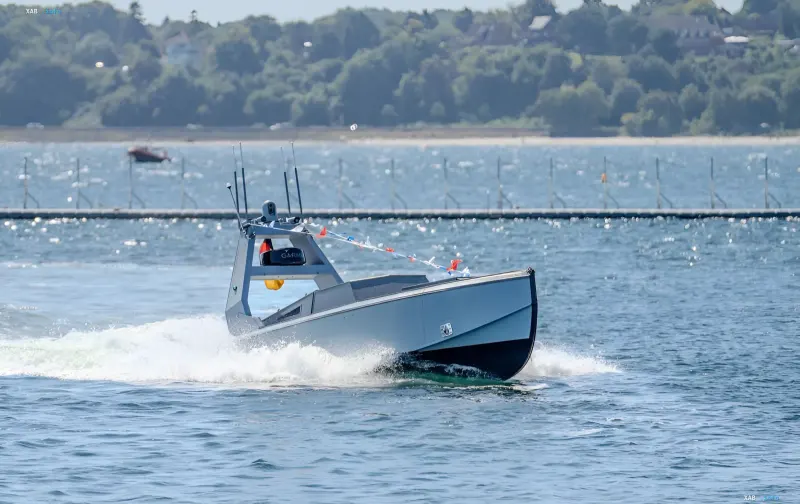
The German Armed Forces (Bundeswehr) have received a new unmanned surface vessel, the Seetaube, developed by the German company STARK based on the Vanta platform. This was reported by RBK-Ukraine, citing a press release from STARK Defence. The vessel is one of the first unmanned boats transferred to the Bundeswehr, marking a significant step in the transition of the German military towards autonomous maritime platforms.
Client and Purpose of the Vessel
According to the press release, Seetaube was fully developed by STARK for the Cyber and Information Space Command (Kommando CIR) in partnership with the Cyber Innovation Hub Bundeswehr. This indicates that the boat is primarily designed not for strike missions, but for reconnaissance and information tasks: enhancing the Bundeswehr's intelligence capabilities at sea and, specifically, locating signal sources. The vessel can serve as an additional mobile point for cross-bearing triangulation and can execute pre-planned missions autonomously.
Characteristics and Tactical Capabilities
Seetaube is a nearly 6-meter unmanned surface vessel (USV) equipped with cameras, radar, and other sensors. In public footage, the apparatus appears as a compact grey vessel with an array of antennas and navigation equipment, moving at speed and leaving a noticeable wake. This configuration allows it to remain at sea for extended periods without a crew, transmitting data for real-time decision-making.
Testing of the Vanta Technological Foundation
The technological foundation of the new vessel is the Vanta maritime unmanned boat from STARK, which underwent testing during the international REPMUS and NATO Dynamic Messenger exercises in Portugal. For nearly a month in the Atlantic, the drones performed various missions daily: escorting high-value targets, monitoring ports, conducting reconnaissance beyond line of sight, and carrying out night ISR patrols. This experience essentially served as a proving ground for the scenarios implemented in Seetaube.
Context: The 'Shadow Fleet' and European Security
The development of unmanned maritime systems is also significant for countering the Russian 'shadow fleet' — a network of vessels used by Russia, in particular, to bypass international sanctions and continue oil exports. Such ships often have opaque ownership structures, use flags of third countries, and may hide or manipulate data regarding their location, complicating shipping monitoring and creating risks for maritime security and critical infrastructure. 'Modern maritime threats require new approaches to observation and control of maritime space. Autonomous platforms can ensure constant presence at sea, reduce the burden on crews, and quickly transmit information for decision-making. This is one of the key advantages of unmanned systems. It is precisely these technologies that Europe needs today to strengthen maritime security,' noted Maxim Cherkis, COO of STARK in Ukraine.
Related Events
The transfer of Seetaube occurs against a backdrop of active dynamics in the field of maritime unmanned systems. For instance, on the night of August 12, 2026, the Armed Forces of Ukraine used long-range missile-drones 'Palianytsia' and 'Peklo' in a single operation for the first time, striking the Russian naval base in Novorossiysk alongside unmanned surface vessels. Earlier, India presented a portable launcher with the Harpy Eagle interceptor drone, designed to counter small unmanned aerial vehicles. The combination of these events shows that maritime drones are ceasing to be merely strike weapons and are becoming a multifunctional tool for reconnaissance, surveillance, and control.