
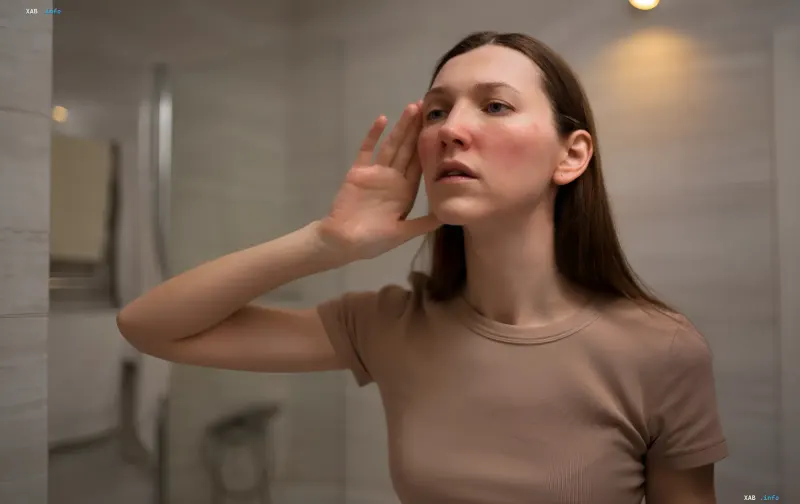
A sudden flush of the cheeks is usually attributed in everyday life to heat, stress, or mild nervousness. Yet in folk tradition, this physiological phenomenon has accumulated an entire field of mystical interpretations. According to a widespread belief, a sudden burning sensation in the cheeks is not merely a vascular reaction but a kind of "signal" from outside: someone is, at that very moment, remembering, discussing, or thinking about you. Styler, an entertainment project by RBC-Ukraine, examined the main versions of this sign and explained the origin of the popular belief about the "black mark from gold," which was supposedly used to check for the evil eye.
The main sign: someone is thinking of you
The most deeply rooted version in folk memory goes like this: if your cheeks suddenly begin to burn for no apparent reason, then at that very moment someone is thinking of you. Our ancestors went further and tried to "decode" the nature of this conversation based on where the heat was located. According to the belief, the right cheek indicated a kind word: you were being praised, remembered with affection, or spoken about in a positive light. The left cheek carried the opposite message — its heat was associated with gossip, criticism, and unpleasant talk behind your back. When both cheeks burned at the same time, the sign was considered the most "loaded": someone was discussing you very actively, and the intensity of the heat, in folk interpretation, could reflect the volume of attention you were surrounded by in other people's conversations.
The version about a specific person's affection
There is also a more "intimate" interpretation. If your cheeks suddenly became hot right after meeting a particular person, folk tradition might have taken this as a sign of their hidden affection or of the fact that they were mentally unable to let you go. Thus, the same physiological reaction — vasodilation of the facial blood vessels — was transformed, within the folk system of coordinates, into a whole set of social "indicators" that, according to our ancestors' beliefs, allowed one to read other people's thoughts and intentions.
The gold test and the "black mark"
One of the most colorful beliefs associated with the cheeks concerns gold jewelry. In everyday life, there was a way to supposedly check whether a person had been subjected to the "evil eye" or some other negative influence: a gold item was rubbed against the skin of the cheek, and the resulting mark was then examined. If a dark or black stripe appeared on the skin, it was interpreted as a sign of the evil eye. If the gold left no visible trace, then, according to the belief, there was no cause for alarm. Notably, this "diagnostic" act had nothing to do with real medical procedures and was based entirely on magical thinking: in folk symbolism, gold was considered a conductor of "energy" and an indicator of hidden influences.
Contradictory evidence
Here, an inevitable clash between two systems of explanation arises. On the one hand, folk tradition consistently interprets the heat and redness of the cheeks as a mystical "channel of connection" with other people's thoughts, and the dark mark from gold as proof of the evil eye. On the other hand, modern medicine and dermatology do not confirm any of these connections. Redness and a sensation of heat in the cheeks have quite specific physiological causes: from vasomotor spasm and reactions to temperature to allergic manifestations, hormonal fluctuations, and stress-induced adrenaline release. As for the "black mark from gold," its appearance is explained in a trivial way: when a gold item is rubbed against the skin, particles of cosmetics, sebum, sweat, or other substances remain on the surface, which darken under pressure and heat. Thus, what folk tradition considered a "sign of the evil eye" is, in everyday terms, an ordinary physicochemical phenomenon. Both versions coexist in the public consciousness: one as a cultural code, the other as a medical reality, and neither cancels the other in the eyes of the adherents of the respective system.
Why the signs continue to live on
Folk beliefs about the cheeks have no scientific confirmation, and the Styler editorial team explicitly emphasizes that they should be regarded as an interesting part of cultural heritage rather than as evidence of mystical influence. Nevertheless, it is precisely such everyday interpretations that vividly demonstrate how our ancestors tried to explain unexplainable bodily sensations and fit them into a logical picture of the world. In an era when neither dermatology nor psychosomatics existed, the "signal of burning cheeks" became an accessible way for everyone to "receive information" about their social environment. Today, despite the advanced state of medicine, these signs retain the function of a cultural ritual: they give a person a sense of control over a situation in which they feel they are the object of someone else's attention. And this, perhaps, is their main and most enduring value — not in the "truth" of the interpretation, but in the fact that they allow a person not to be left alone with their own body, but to always find an external, social meaning for its reactions.