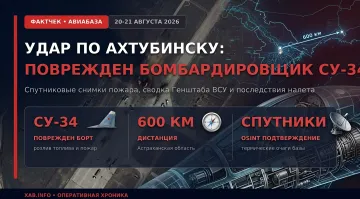
The strike on the Akhtubinsk airfield in the Astrakhan region, recorded on August 20–21, 2026, became another link in the strategy of systematically targeting Russian aviation infrastructure. The key significance lies in the shift of tactical focus: Ukraine's defense forces are shifting the center of gravity from intercepting aircraft in the air to destroying them at permanent and temporary bases. This approach is more economically and logistically effective, as damaging equipment on the ground requires fewer munitions and does not involve the risk of losing a strike UAV when encountering air defense systems in the airfield zone.
Chronicle and geography of damaged objects
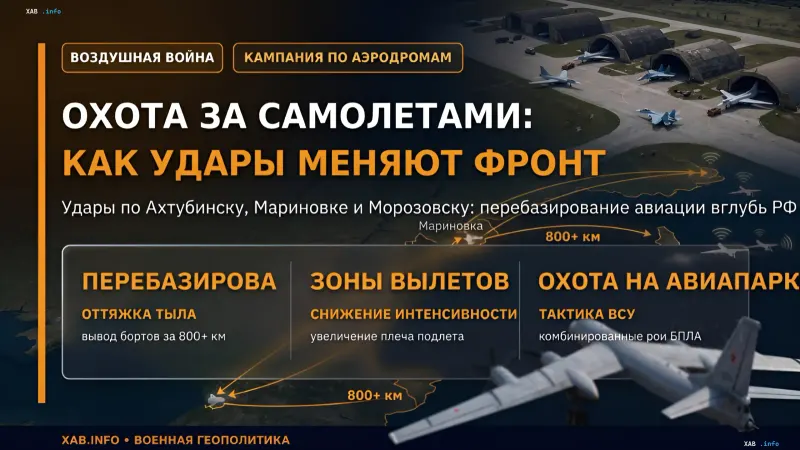
A comprehensive overview of the campaign allows us to identify three key objects deep within Russian territory. The Morozovsk airfield in the Rostov region (approximately 280 km from the border), where Su-34 and Su-24M aircraft were based, suffered damage to aviation weapon storage facilities and stands for guided air bombs. Marinovka in the Volgograd region (about 450 km), with squadrons of Su-34 and Su-24MR, received strikes on maintenance hangars and warehouse complexes. Akhtubinsk in the Astrakhan region (about 600 km), where the 929th State Flight Test Center with Su-57 and Su-34 aircraft is located, according to Korrespondent.net, recorded damage to fifth-generation fighter jets and front-line bombers.
Tactical consequences for the aviation campaign
The main consequence of dispersal is an increase in flight range. The Russian command is forced to withdraw combat-ready squadrons to airfields within a radius of 700–1000 km from the front line, which directly increases flight time and engine resource consumption of the AL-31F and AL-41F engines. In combination with the need for aerial refueling, this leads to a 20–30% reduction in the daily number of aircraft sorties in key directions, which is statistically confirmed by a decrease in the intensity of guided air bomb drops.
Logistical and resource pressure
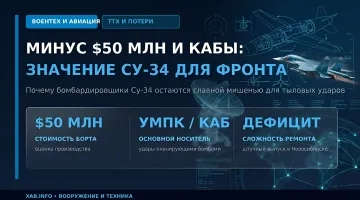
A long-term factor of vulnerability is logistical complexity. The delivery of FAB air bombs with UMPK control modules to remote airfields overloads the railway and road arteries of the rear, creating new vulnerable nodes for strikes. Moreover, dispersal across multiple sites increases the need for air defense means at each of them, which redistributes scarce anti-aircraft complexes from front-line directions to rear airfields.
Contradictory data
There are inconsistencies in available sources regarding quantitative parameters and the nature of the damage. First, the distance to Akhtubinsk in the detailed table is indicated as about 600 km, whereas the campaign summary formulations mention a threshold of "over 800+ km," which may reflect either the difference between a specific object and the general dispersal radius or inaccuracies in the primary sources. Second, for Akhtubinsk, damage to Su-57 and Su-34 airframes is confirmed (citing Korrespondent.net), whereas for Morozovsk and Marinovka, the destruction of warehouses and hangars is claimed; that is, the nature of the damage to the objects differs and is not always comparable in terms of the degree of damage. These discrepancies require additional verification before a final assessment of the scale of losses.