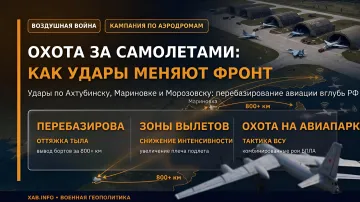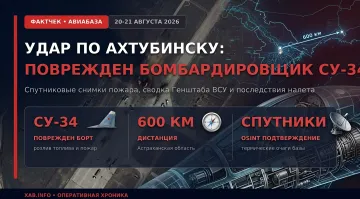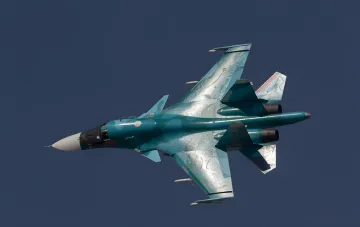
The Su-34 (NATO reporting name: Fullback) is a frontline twin-seat fighter-bomber operating within the Russian Aerospace Forces as the primary carrier of guided glide bombs with guidance and correction modules (UMPK). From a macroeconomic perspective on losses, each aircraft shot down or destroyed on the ground represents not just a single unit of equipment, but a multi-year production cycle, capital invested in microelectronics and titanium structures, and a qualified crew formed over years. Therefore, strikes against airfields and rear aviation nodes where these machines are based are viewed as a tool to reduce the density of enemy fire strikes at tactical depth without the need to intercept every individual aircraft.
Tactical Role: The KAB Drop Conveyor
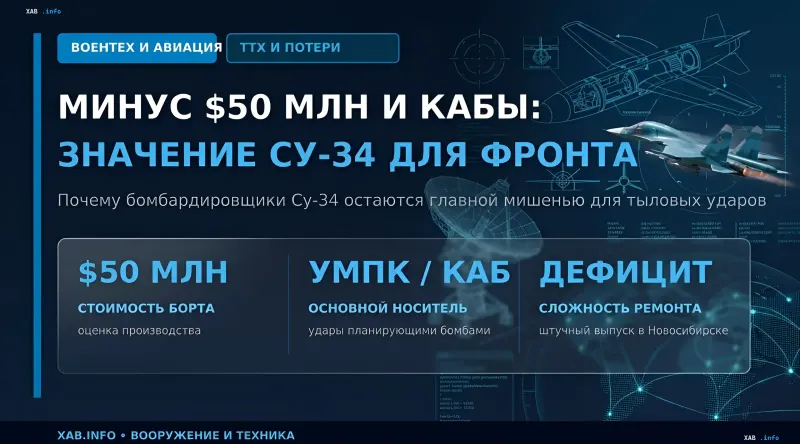
According to military analysts, the Su-34 ensures the dropping of glide bombs at a distance of 40–70 km from the front line, allowing the crew to operate outside the engagement zone of most medium-range military air defense systems. The aircraft's combat load reaches 8 tons and includes guided bombs FAB-500 and FAB-1500, as well as thermobaric munitions. During periods of active offensive operations, one crew can perform up to two or three combat sorties per day, turning the Su-34 fleet into a virtually conveyor-belt source of fire strikes on enemy positions, depots, and communication nodes.
Economics of Losses and Reproduction
The market and replacement cost of a modern Su-34M / Su-34E modification aircraft is estimated by experts to be in the range of $45–50 million. For comparison: this is comparable to the price of a large regional-class civilian aircraft and far exceeds the cost of a tactical drone. Consequently, every loss of such a carrier is equivalent to the withdrawal of a significant amount of capital from circulation, which cannot be quickly compensated from reserves. Under conditions of sanctions restricting the supply of imported microelectronics and precision machine tool parks, the restoration of the fleet using domestic capacities remains a structurally limited process.
Industrial Constraints of the Novosibirsk Plant
The key enterprise for the production of the Su-34 is the Novosibirsk Aircraft Plant named after V.P. Chkalov. According to available estimates, its annual output of new aircraft does not exceed 8–12 units. Limiting factors cited include a shortage of imported component bases, the complexity of precision machining, and the long assembly cycle of the titanium armored capsule of the cockpit, which protects the two crew members. These production parameters determine the upper limit of loss replacement rates and explain why even a moderate level of equipment destruction on the ground leads to an accumulated reduction in the available fleet over several months.
Crew Shortage and Tactical Consequences
Aside from the equipment, a critical resource is human capital: training an Su-34 commander and bombardier-operator takes from five to seven years. This means that disabling an aircraft on the ground simultaneously deprives the adversary of both the machine and the formed crew, whose replacement is impossible within the operational horizon. Combined with industrial constraints, this forms a long-term trend of reducing the density of bomb strikes at tactical depth, which has direct consequences for the pace of offensive operations and enemy logistics.
Contradictory Data
There is a discrepancy in key figures in open sources and expert assessments. The cost of the aircraft is stated either as a fixed figure of around $50 million or as a range of $45–50 million depending on the modification and the inclusion of onboard equipment costs. The annual output of the Novosibirsk plant is also cited as a range of 8–12 aircraft rather than an exact value, reflecting the lack of officially confirmed production reports. Similarly, sortie intensity (2–3 per day) and UMPK application range (40–70 km) are presented as estimated parameters rather than fixed standards. These discrepancies are not mutually exclusive but indicate that exact values remain classified and are published as expert intervals.
Thus, the Su-34 remains one of the most economically and tactically significant elements of the Russian strike aviation: its losses simultaneously affect the production, personnel, and operational contours of the military machine. For the parties to the conflict, this determines the priority of rear attacks on base and maintenance nodes of these machines as a tool for the long-term reduction of enemy firepower.