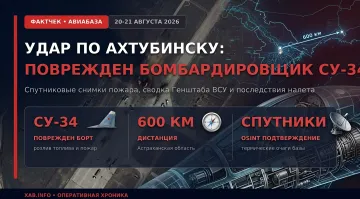
On the night of August 20, 2026, the Ukrainian Defense Forces struck the Russian military airfield 'Akhtubinsk' in the Astrakhan region, located near the settlement of the same name. According to the Telegram channel 'Absolutely Reliable Source', cited by RBC-Ukraine, the attack took place between 00:30 and 01:00. Published satellite images show at least two impact points on the base. The main result of the strike is damage to a Su-34 front-line bomber, with fuel spills visible on the footage near the aircraft.
Chronology and details of the strike
The operation was carried out as part of a series of night strikes on military infrastructure within Russian territory. According to reports, on the same night, GUR operators, together with the Defense Forces, struck several important military objects, including two airfields from which strike drones were launched against Ukrainian settlements. The strike on 'Akhtubinsk' demonstrates the expansion of the geography of 'long-range' operations: previously, the 'Savasleyka' airfield was hit, where missile carriers used against Ukrainian cities and villages are based — this is approximately 700 km from the border, while 'Akhtubinsk' is even further, at a depth of about 1,600 km.
Aircraft analysis: camouflage and versions
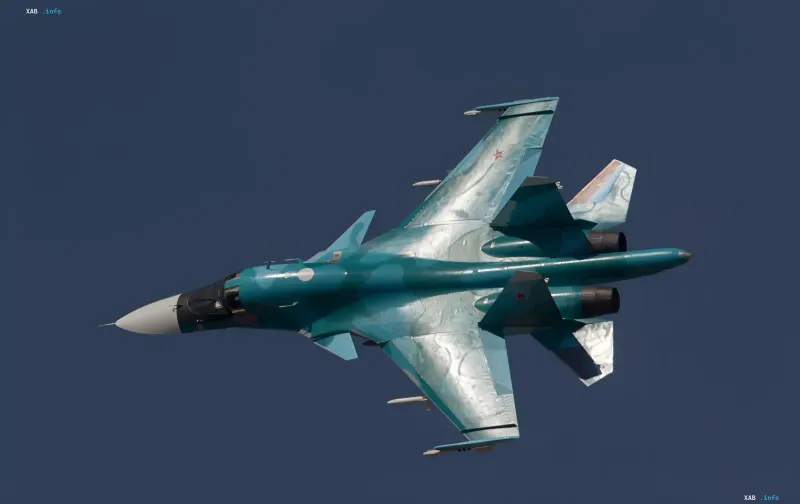
An analysis of the camouflage paint of the damaged aircraft suggests that it could be the Su-34E export modification. At the same time, experts allow that it may be a flying laboratory based on the Su-34 or an aircraft with a special primer coating applied to new machines before final painting. Flying laboratories of the Russian Aerospace Forces are traditionally used to test new onboard systems, aviation weapons, and electronic warfare means in real flight conditions, which makes the loss or damage of such an aircraft particularly sensitive for the adversary.
Aircraft relocation tactics after the shelling
Satellite data indicate that after the strike, the Russian side promptly relocated the remaining aircraft on the airfield territory or evacuated them to other bases. Such behavior is characteristic of dispersal tactics aimed at reducing vulnerability during repeated raids, but it simultaneously confirms that the strike achieved its goal and forced the adversary to significantly change logistics at the base.
Contradictory data
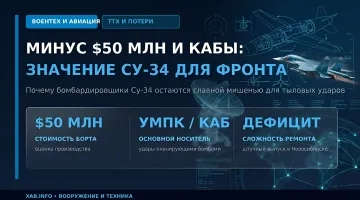
There is a discrepancy between sources regarding the assessment of the attack results. RBC-Ukraine, TSN, and a number of other media outlets speak of the damage of the Su-34 bomber, confirming this with satellite footage showing fuel spills. Meanwhile, the headline of the UNIAN material formulates the event as the destruction of a 'new Russian fighter'. The difference between 'damaged' and 'destroyed' is fundamental: the first two statuses are visually confirmed, while the statement about the complete destruction of the aircraft at the time of publication is not supported by independent satellite evidence. Furthermore, TSN estimates the cost of the damaged aircraft at approximately $50 million, however, the exact identification of the modification (Su-34E, flying laboratory, or aircraft on primer) remains a subject of expert assessment and is not officially confirmed by either side.
Characteristics of the Su-34 and significance of the loss
The Su-34 is a front-line bomber capable of using guided (KAB) and free-falling (FAB) aviation bombs of various calibers, launching air-to-surface missiles (Kh-59/69, Kh-31/35U), as well as carrying reconnaissance and electronic warfare pod containers. Damaging such a carrier on its own soil, deep inside the territory, raises questions about penetrating multi-level air defense and the vulnerability of airfields that Russia uses as launchpads for strikes against Ukrainian infrastructure.