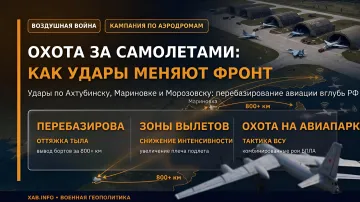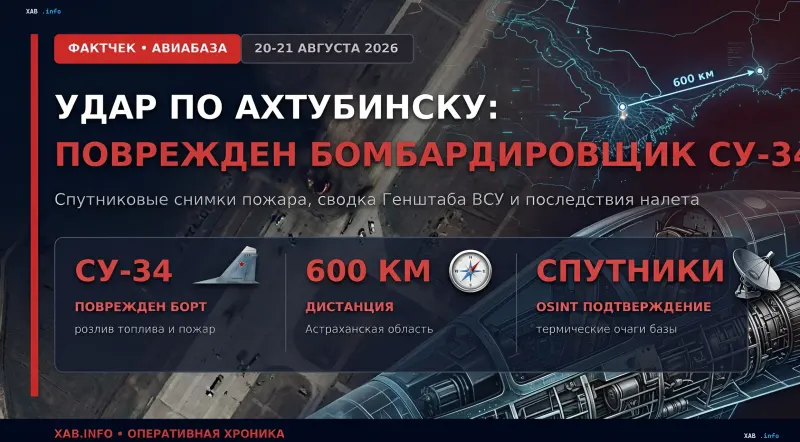
On the night of August 20–21, 2026, the Defense Forces of Ukraine executed a combined strike using long-range unmanned aerial vehicles (UAVs) against the Akhtubinsk military airfield in the Astrakhan region, located approximately 600 km from the line of contact. According to a combination of intelligence data, official reports from the General Staff of the Armed Forces of Ukraine (AFU), and independent OSINT resources, a Su-34 front-line bomber sustained significant damage while parked on an open apron at the airbase. This event is recorded within the context of a sustained trend expanding the geography of strikes against rear-area Russian aviation assets, which is directly relevant to assessing the effectiveness of the tiered air defense system.
Chronology of the Attack and Air Defense Operations
According to available information, around midnight in the Akhtubinsk district, duty air defense crews and mobile fire groups were activated. Local authorities and the head of Akhtubinsk, Alexander Sivakov, confirmed the drone strike, reporting the fall of debris within the city limits and damage to the glazing of several multi-story residential buildings. Despite interception attempts, some strike drones penetrated to the flight fields and technical areas, where a series of explosions followed by the ignition of aviation fuel was recorded. The fact of breaching the duty air defense assets indicates persistent gaps in the protection system for rear airfields at significant distances from the front.
Confirmation of Damage and Satellite Verification
The General Staff of the AFU and monitoring OSINT resources (including Exilenova+) published high-resolution satellite images capturing thermal hotspots and fire traces directly in the aircraft dispersal zone. The images show kerosene spills and traces of the UAV warhead detonation near the Su-34 fuselage. Analysts assess that the aircraft sustained critical damage to the skin, wing surfaces, and onboard radio-electronic equipment, ruling out its operational use without prolonged factory repairs. Thus, even without the total destruction of the aircraft, its indefinite grounding represents a real loss to the combat potential of the air force.
Contradictory Data
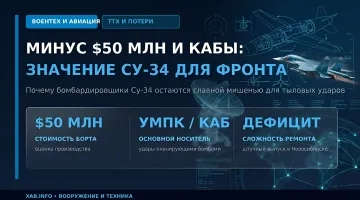
There are discrepancies between sources regarding the assessment of the degree of damage and the scale of losses. The majority of publications (including the General Staff of the AFU briefing and several Ukrainian media outlets) use the formulation "damaged," emphasizing that the aircraft is grounded but not physically destroyed. However, in some URL tags and headlines of adjacent materials, a more categorical formulation "destroyed" appears, as well as the mention of a "fighter" instead of the Su-34 bomber, which could be related to both terminological inaccuracies and confusion with the 2024 precedent when a Su-57 fighter was damaged at the same airfield. Furthermore, one source estimates the material damage from the attack at approximately $50 million; however, this figure is not confirmed by independent audit and is of an estimated nature. Differences in terminology ("damage/destruction") and quantitative damage assessment require additional verification before final inclusion in analytical reports.
Macro Context: Vulnerability of Rear Airbases and Precedents
The Akhtubinsk airfield has repeatedly been the target of successful strikes: in the summer of 2024, the newest fifth-generation Su-57 fighter was damaged there for the first time in history. The repeated strike on the Su-34 apron confirms the systemic nature of the problem — placing combat aircraft on open areas far from the front does not provide sufficient protection against long-range drones. From a macroeconomic and military-technical perspective, each heavy aviation unit taken out of service means not only direct financial losses but also a reduction in the potential for delivering guided air bombs, which affects the balance of power in certain sectors.
Long-term Consequences and Damage Assessment
The long-term consequences of the attack are linked to the need to revise the doctrine of aviation deployment in the deep rear: open aprons at remote airfields demonstrate increased vulnerability, which may accelerate the transition to dispersal, the use of shelters, and mobile sites. Financial damage, according to some sources, is estimated in tens of millions of dollars, although the exact amount depends on the nature of the damage and the duration of factory repairs. In total, the incident increases pressure on the Russian air force's air defense system and logistics and serves as an indicator that the expansion of the range of strike UAVs continues to erode traditional notions of "safe depth" for rear objects.