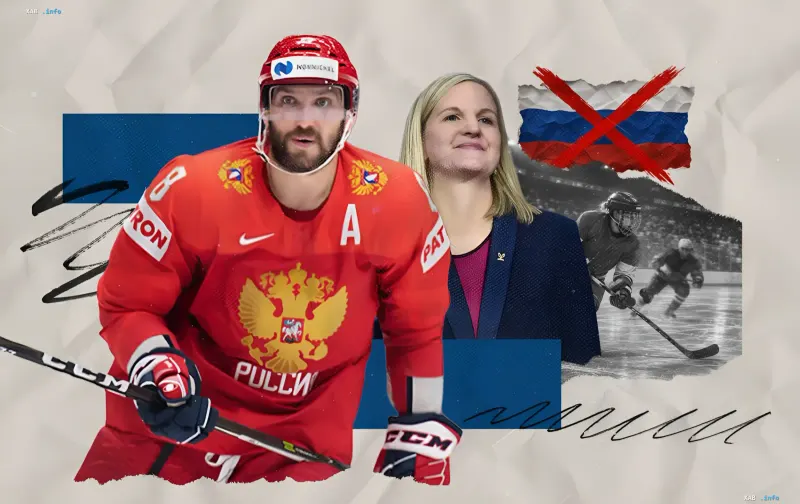
On October 30, 2026, the Court of Arbitration for Sport (CAS) issued a verdict upholding the appeal of the Ice Hockey Federation of Russia and overturning the decision by the International Ice Hockey Federation (IIHF) that had banned Russian national teams from participating in the 2026/27 season. The arbitrators concluded that the IIHF had not provided sufficient evidence to justify the continued exclusion of Russian teams on the grounds of safety. Consequently, CAS ordered that Russian teams be allowed to participate in IIHF championships. The first practical test of this decision will be the World Junior Championship in Canada, starting on December 26, 2026.
Timeline of Restrictions: From February 2022 to Arbitration
Following the full-scale invasion of Ukraine by Russia in February 2022, Russian and Belarusian teams were suspended from most international hockey tournaments. The restrictions were extended annually, citing security risks and the inability to guarantee appropriate conditions for all participants. In January 2026, the IIHF Council again decided not to reinstate Russian teams for the 2026/27 season. The Russian side appealed this verdict. In May, the IIHF's own disciplinary board abolished the previous decision and ordered the federation to reconsider the matter, taking into account safety, organizational capabilities, and sporting integrity. In July, after a second review, the IIHF again refused to admit Russia to most championships of the 2026/27 season. It was only after this that the Russians appealed to CAS.
Legal Logic of the Verdict and the IIHF's Position
Evgeny Pronin, a lawyer and managing partner at Pronin&partners, commented on the legal aspects of the case. According to him, CAS did not consider the issue of Russia's responsibility for the war, but rather whether the IIHF had sufficiently justified the exclusion of Russian teams under its own rules. "According to the released summary of the decision, the arbitrators decided that references to safety and organizational risks without sufficient proof are not enough to exclude teams from competitions. Therefore, the IIHF decision was overturned," the lawyer explained. He emphasized that this does not mean Russian sports are recognized as "above politics" or that risks are absent: the federation is obligated to prove specific risks with proper evidence. Pronin also noted that the full reasoning of the decision had not yet been released at the time of the comment, so a final legal assessment should be made after publication. The IIHF itself stated it was disappointed with the verdict, disagrees with it, but will comply with the CAS decision. The federation must now assess the practical consequences of the Russians' return, as some tournaments are already in advanced stages of preparation.
International Resistance: Six Federations Opposed
The CAS decision triggered a harsh reaction in the hockey community. Six national federations—Finland, Sweden, the Czech Republic, Latvia, Norway, and Denmark—declared their refusal to play against Russian teams as long as the war against Ukraine continues. Finland and the Czech Republic additionally opposed the arrival of Russian teams for competitions in their countries. Germany, which is set to host the 2027 Men's World Championship, also clarified its position. Canada, hosting the Junior Championship, announced visa restrictions, which creates additional organizational complexities for implementing the CAS verdict in practice.
The Flag Issue and the Broader Context of Return
An important nuance: the CAS decision did not determine under which flag Russian teams should perform. The issue of national symbols was not the subject of the arbitration. However, in a broader context, the Russian delegation is already represented at the Youth Olympic Games, and in a number of sports, Russian athletes have been given the opportunity to perform under national symbols, while others perform under a neutral status. This forms a precedent-setting background against which the hockey decision will be evaluated.
Countermeasures from Ukraine
For Ukraine, the return of Russian athletes to the international arena creates additional challenges. The main tools for opposition remain diplomatic pressure on sports federations and Olympic committees, the use of legal mechanisms—including the possibility of appealing decisions in national and international courts—as well as the organization of boycotts of individual tournaments. The practice of the six hockey federations that publicly declared their unwillingness to play against Russians demonstrates that there is significant political resource for resistance at the level of national associations, even with formal admission from international federations.