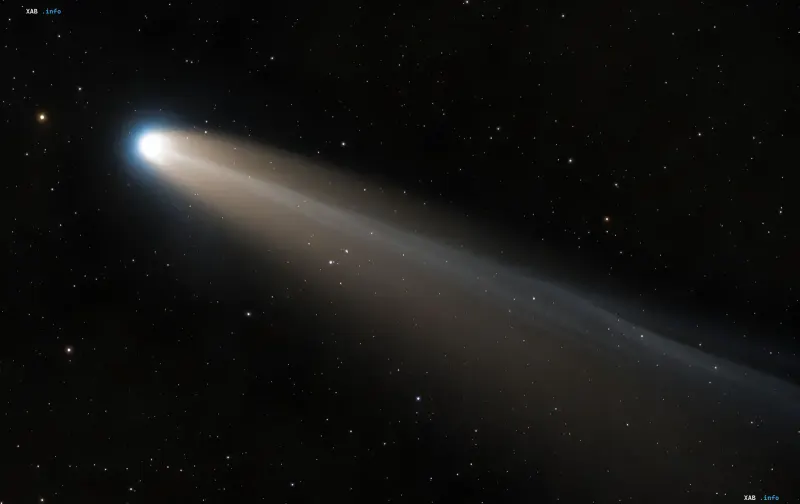
In the world of astronomy, an unprecedented event has occurred: a celestial body, comet 41P/Tuttle-Giacobini-Kresak, has suddenly reversed its direction of rotation. This unique phenomenon was recorded as the space object approached the Sun.
The Mystery Unveiled by Hubble
The key data that enabled this discovery were obtained back in 2017, when the comet passed perihelion—the point in its orbit closest to our star. However, the detailed analysis of the information transmitted by the Hubble telescope was conducted by researcher David Jewitt from the University of California at a later date.
The specialist found that the cause of such a drastic change in dynamics was powerful gas sublimation. Under the influence of intense solar heat, the comet's icy nucleus began to actively release gas, creating an effect comparable to the operation of rocket engines.
The "Cosmic Carousel" Effect
Dr. Jewitt explained the mechanism of the process using a simple and vivid analogy. Jets of gas erupting from the surface of the celestial body act like small engines. If these emissions are distributed unevenly, they can radically change the comet's rotation.
"It is akin to pushing a carousel: if it is spinning in one direction, and you start pushing against the motion, you can slow it down, stop it, and reverse it," the scientist noted.
In addition to the change in rotation direction, the surface of 41P in 2017 appeared significantly less active compared to observations from 2001. Usually, such transformations in comet behavior take hundreds of years, but in this case, massive changes occurred in just 25 years.
Threat of Disintegration and Scientists' Hypotheses
Computer modeling based on the obtained data points to potentially dangerous consequences for the object. Due to the speed of rotation, centrifugal forces may become so great that they simply tear the comet apart.
Specialists have proposed two hypothetical scenarios to explain such behavior:
- The comet releases an anomalously large amount of gas, creating powerful reactive thrust.
- 41P is a fragment of a larger object that previously broke off from the main body.
Origin and Orbit
Comet 41P/Tuttle-Giacobini-Kresak originates from the Kuiper Belt—an area located 30–50 astronomical units from the Sun. The object's orbit returns it to the inner Solar System every 5.4 years, allowing it to be classified as a short-period comet.
Currently, scientists have cataloged between 4,000 and 5,000 such objects. For comparison, even further away lies the Oort Cloud, the outer boundary of which extends to a distance of 100,000 astronomical units. It is from there that long-period comets arrive, whose journeys can last thousands of years.