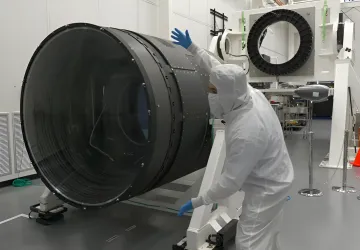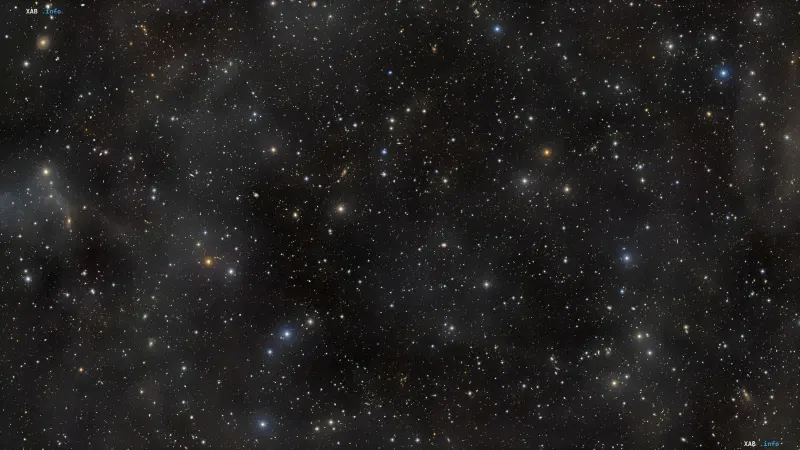
Astronomy has reached a new level. The Vera C. Rubin Observatory has released its first scientific image captured by the LSST Camera — the largest digital camera in the world. The image features more than 500,000 galaxies and over 50,000 stars in the COSMOS field, an area of the sky considered one of the most important for studying the Universe.
A Window into the Deep Past
The image was created by combining hundreds of individual observations. It covers a patch of sky located far from the plane of the Milky Way, where there are relatively few stars and interstellar dust. This allows telescopes to observe a vast number of distant galaxies, whose light has traveled to Earth for billions of years. The farther away an object is, the earlier epoch of the Universe's existence it represents.
A Benchmark Field for Science
The COSMOS field has been studied since 2003, when it was first observed by the Hubble Space Telescope. Over two decades, this area has been investigated by dozens of major observatories across the spectrum from radio waves to X-rays, making it one of the primary benchmark fields for comparing astronomical data.
The Vera C. Rubin Observatory adds a new capability to these observations: a combination of deep imaging, a wide field of view, and regular repeated observations. This will allow scientists to study not only the structure of distant galaxies but also to track changes — such as the appearance of supernovae and other transient cosmic phenomena.
Early Data Access
The release coincides with the launch of Early Data Preview 2 (EDP2) — the first demonstration of scientific data obtained by the LSST Camera. It includes observations carried out from April 2025 to January 2026. The catalog features combined images of an area of approximately 3,000 square degrees — roughly 1/6 of the entire visible southern sky.
The full-scale Legacy Survey of Space and Time (LSST), planned for 10 years, has only just begun, so EDP2 is not its primary data release. Nevertheless, this dataset will already allow astronomers to test data processing methods, prepare analysis tools, and begin scientific research.
In the second phase of EDP2, expected between October and December 2026, data from individual observations will be published, including images of changes obtained by comparing shots from different epochs. Access to the data is already open to scientific organizations in the USA, Chile, and international project participants, and it will become publicly available in 2 years.