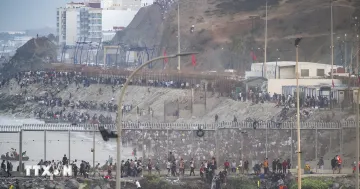
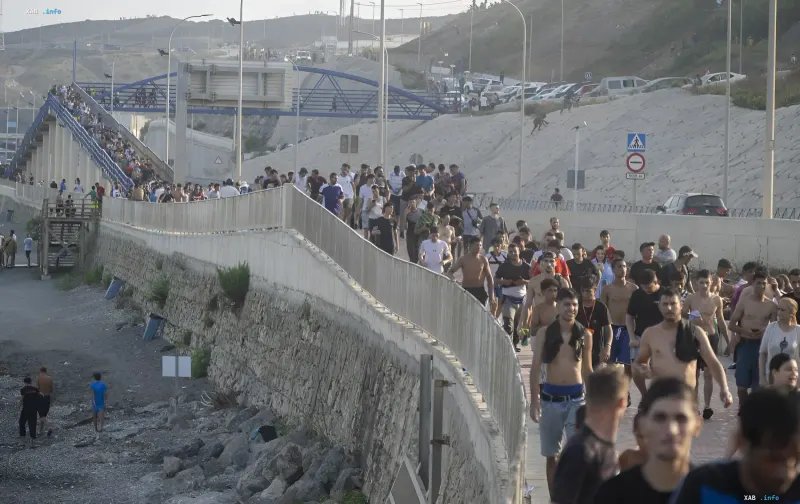
The Spanish enclave of Ceuta, which has become the epicenter of an unprecedented migration crisis in recent days, is gradually returning to normal life. The mass breach, during which approximately 60,000 people crossed the border in a single day, is behind us, but the consequences of the event continue to be felt. According to the latest estimates by the State Security Service, about 73,500 migrants have already left the territory of the enclave.
Complex statistics and hidden groups
Experts emphasize that the figure of 73,000 people is approximate. It may include people who arrived in the city several days before the main event, as well as those who entered and left Ceuta repeatedly. Despite the mass exodus, the situation in the city has not fully stabilized. Small groups of migrants who refuse to return voluntarily are still patrolling the central streets, wooded areas, and outskirts.
The police note that it is extremely difficult to calculate the exact number of people remaining. Groups of three to five people are periodically spotted in different districts of the city, creating an additional burden on law enforcement agencies.
Tragedy at the border: discrepancy in figures
The price of the mass breach turned out to be high. The Government Delegate in Ceuta, Miguel Angel Perez, updated the data on the dead: the number of bodies retrieved from the sea reached 72. Officials emphasized that before the event on Thursday, the authorities had no intelligence about a planned breach.
However, independent sources provide more alarming figures. The United Association of the Civil Guard (AUGC) estimates the number of deaths during the incident at more than one hundred people. According to the association, nearly 60,000 people attempted to enter the enclave that day, recording the largest migration crisis in the history of Ceuta.
New barriers and military operations
To prevent the recurrence of such events, the authorities have taken decisive measures. The Ministry of the Interior reported the full launch of maritime containment barriers around the breakwater. This is a pneumatic structure 500 meters long, which rises 30–70 centimeters above the water and extends one meter underwater. Additionally, the line is protected by moored buoys installed by the Spanish Navy.
Military units were sent to the city to stabilize the situation. Currently, border crossings in the morning are proceeding as usual, although an increase in passenger flow is expected in the coming hours as part of the "Strait Crossing" operation. Authorities state that the city is gradually returning to daily life, but acknowledge that "there is still a lot of work ahead" to eliminate the consequences of the crisis.