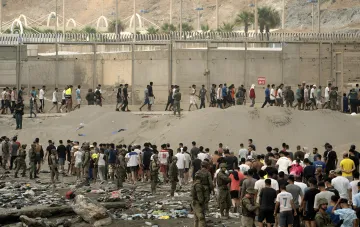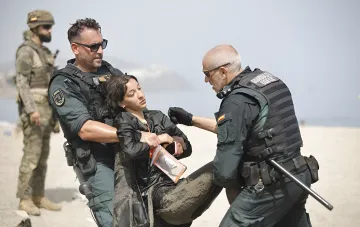
The Spanish government has made an unprecedented decision: to deploy military personnel to the autonomous city of Ceuta. The cause is a massive influx of migrants who crossed the border with Morocco within a single day. According to official estimates, between two and three thousand people entered the enclave, pushing local law enforcement agencies to the brink of collapse.
The situation has spiraled out of control
Local authorities have appealed to Madrid to declare a state of emergency. Rashid Sbahi, head of the Civil Guard officers' association in Ceuta, described the situation as "absolute chaos." According to him, the border infrastructure has effectively ceased to function, and it is impossible to name the exact number of people who crossed, as the flow is counted in the thousands.
In response to the crisis, the Spanish government announced the deployment of 60 military personnel. Their task is to reinforce Civil Guard units and assist in ensuring security within the enclave. To assess the situation on the ground, Prime Minister Pedro Sánchez, together with Interior Minister Fernando Grande-Marlaska, will personally visit Ceuta.
Echoes of the 2021 events
The current situation bears a strong resemblance to the events of May 2021. At that time, around 10,000 migrants from Morocco and sub-Saharan African countries flooded into Ceuta over a few days. Many of those who arrived were minors. The small city, with a population of about 85,000, then faced a major humanitarian crisis.
Ceuta, being a Spanish enclave in North Africa, along with Melilla, remains one of the key land routes for illegal migration into the European Union. Tensions here are traditionally high, however, this latest breach caught the authorities by surprise.
Reaction of Morocco and the context in Europe
According to the Spanish Ministry of the Interior, Moroccan authorities are cooperating with Madrid to stabilize the situation. The ministry stated that Moroccan law enforcement agencies are detaining a significant number of people attempting to cross the border illegally.
The events in Ceuta are taking place against the backdrop of tightening migration policies in other European countries. In Germany, for example, the possibility of using artificial intelligence to speed up the processing of asylum cases is being considered. At the same time, rules for receiving social assistance for Ukrainians in Germany have been tightened: basic payments may now be completely stopped in case of refusal to work. Previously, the United Kingdom also introduced norms requiring some refugees to return funds spent on their maintenance to the state.