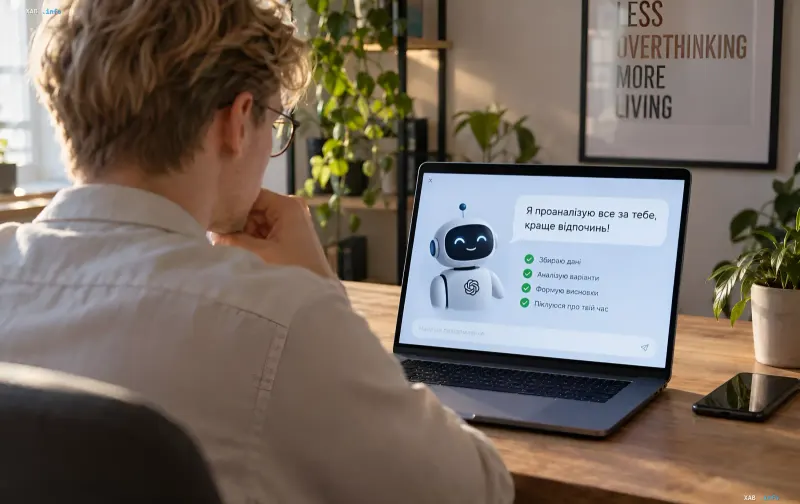
The emergence of ChatGPT and other generative language models has transformed artificial intelligence from a specialized technical tool into a mass cultural phenomenon. While neural networks previously operated as an invisible layer of everyday life — in Amazon and Netflix recommendation algorithms, spam filters, navigators, and machine translation services — users now interact with AI directly through simple text prompts. In just a few years, large language models have become synonymous with the entire concept of 'artificial intelligence' in global public discourse. And along with this shift comes a question that has yet to be fully understood: are we getting used to blindly delegating our own decisions to algorithms, gradually losing our own common sense?
From the 1943 Neural Network to the Pocket Chatbot
The history of artificial intelligence research dates back to the mid-20th century. In 1943, the first mathematical model of a neuron was described — the so-called 'Pitts-McCulloch machine' (referred to here as the Wilson machine), laying the groundwork for subsequent research. In 1950, Alan Turing published a paper proposing his famous test, a criterion to evaluate whether a computer is capable of exhibiting behavior indistinguishable from that of a human. The term 'artificial intelligence' itself only became established as a research field in 1956 at the Dartmouth Conference, where a group of scientists first formulated the tasks we today associate with AI. For the average user, however, the technology only became truly close and tangible when it became possible to converse with it in natural language — without programming, without special interfaces, simply by entering a text prompt.
Cooking a Chicken via Chatbot Recipe: An Illustration of Cognitive Delegation
One of the striking everyday examples cited by the RBC publication is the story of a person who decided to roast a chicken using a recipe provided by a chatbot. The program contained errors, including instructions on how to use a culinary thermometer. Despite a warning from another person, the user continued to trust the algorithm's advice and nearly ruined the dish. At first glance, this is an amusing domestic episode. But taken together with dozens of similar cases, it illustrates a growing phenomenon that researchers call 'cognitive delegation': by transferring routine and even non-routine decisions to artificial intelligence, people begin to rely less on their own life experience, intuition, and basic logic. The algorithm is perceived as an authority whose word is not subject to re-verification.
The 'Technological Singularity' According to Altman
OpenAI CEO Sam Altman stated in recent public speeches that humanity is at a stage he associates with the concept of technological singularity — the moment when the boundary between artificial and human intelligence begins to blur. Such formulations from one of the industry's most influential tech leaders set the tone for the entire public discussion: AI ceases to be 'just another application' and becomes a subject of philosophical and existential debate. Regardless of how literal the category of 'singularity' is in this context, the very fact that such statements are made by the head of the company that created ChatGPT underscores the scale of the shift that has occurred over the past few years.
Impoverishment of the Information Space and the Crisis of Reading Culture
Beyond the direct delegation of decisions, the widespread proliferation of AI carries more hidden challenges. Short automated responses in search engines and aggregators discourage users from independently reading full materials, cross-referencing data across multiple sources, and building their own lines of reasoning. Instead, a person accepts as a ready-made conclusion what the algorithm has generated based on an aggregation of input data that does not always reflect the real picture. Reading culture, already enduring a difficult period in the digital media era, is accelerating its decline: the mass use of language models to generate summaries, analytical notes, and reports makes text even more homogeneous and formulaic. Language models, in turn, bring their own hidden patterns into communication — phrasings, argumentation structures, rhythm — which gradually shape new language habits in younger generations and, consequently, influence how public opinion is constructed and transmitted.
Critical Thinking as the Last Line of Defense
The advent of ChatGPT marked a technological and public turning point comparable in scale to the mass adoption of the internet. However, as analysts emphasize, it will take years, and perhaps decades, for society to fully assess the consequences of this shift and understand whether the benefits of automation and knowledge accessibility outweigh the risks of cognitive dependence on algorithms. In the meantime, as AI generates texts, images, and even scientific hypotheses with growing speed, the primary tools for humans to combat disinformation and self-deception remain two skills immune to automation: fact-checking and critical thinking. The ability to question an algorithm rather than simply accepting its answer is arguably the key skill of the coming decade.