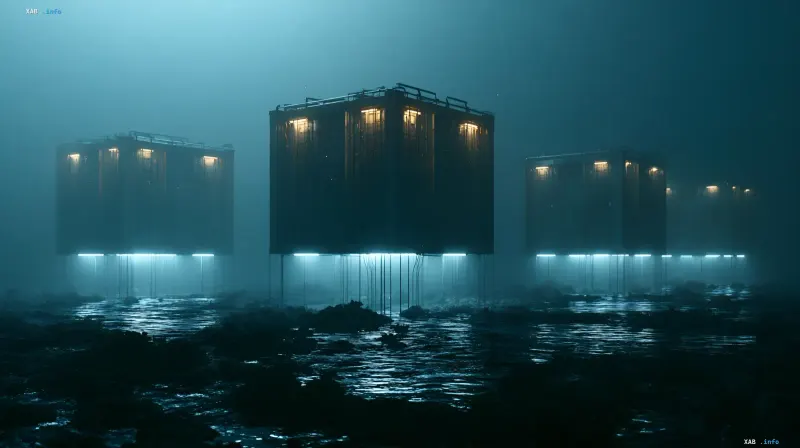
According to a comprehensive patent analysis of 168 documents registered in various jurisdictions from 2006 to June 2026, Chinese companies and scientific institutions now control approximately 80% of the global patent pool for underwater data center (UDC) technologies. This is reported by researchers who studied the industry's evolution from early experimental applications to modern integrated engineering solutions. Underwater data centers are viewed as a promising direction for reducing energy consumption and operating costs for computing power, and patent activity in this sphere has become an indicator of national technological leadership.
From Sealed Enclosures to Industrial Solutions: Industry Timeline
During the early phase, between 2006 and 2015, UDC development was primarily led by companies and scientific institutes from the USA, Norway, and Canada. Efforts were mainly directed toward solving basic engineering challenges — creating high-pressure hermetic enclosures and subsea structures capable of withstanding the extreme conditions of the ocean floor. The pace of patent activity during this stage was modest: the number of new applications did not exceed three per year, indicating a primarily research-oriented approach.
A turning point occurred between 2015 and 2020, when the number of patent applications grew significantly. Developers shifted their focus from merely testing the feasibility of placing servers underwater to ensuring their long-term and reliable operation. Cooling systems utilizing natural water flow and power supply schemes that minimize transmission losses became the center of attention. The industry transitioned from a conceptual phase to an engineering one, where the key criterion shifted from demonstrating operability to stability under multi-year operation conditions.
Microsoft Natick Experiment as a Starting Point
One of the most famous and cited experiments in the industry was Microsoft's Project Natick. In 2018, an underwater data center was deployed off the coast of Scotland, becoming the first industrial test of its kind. After two years of operation, the server failure rate in the underwater installation was approximately eight times lower than in the control group of land-based data centers. This result confirmed the key advantage of underwater placement: stability of temperature and humidity, the absence of active air conditioning systems, and reduced mechanical stress on components. Project Natick became a catalyst for global growth in patent activity and drew the attention of major technology companies to subsea infrastructure.
China's Leap: Modularity, Energy, and Intelligent Management
Since 2021, leadership in patent activity has shifted to China. Researchers note a qualitative shift in the nature of developments: the industry has moved toward complex engineering solutions including modular server clusters, subsea equipment maintenance systems, the integration of various energy sources — including tidal and wave generators — and intelligent infrastructure management based on machine learning algorithms. Developers intend these technologies to lower the operating costs of subsea UDCs and enable scaling to an industrial level. Analysis shows that Chinese developments account for about 80% of the reviewed patents, solidifying China's dominant position in this promising sector.
Competitive Landscape and Perspectives
South Korea took second place in the number of patents, with Korean developers focusing primarily on information module designs and specialized equipment for subsea deployment. Thus, while the Chinese strategy is oriented toward creating holistic “turnkey” systems, the Korean strategy focuses on highly specialized components and modules. Other countries in the patent race — the USA, Norway, and Canada — retain a presence in niche areas, but their share in the overall pool is significantly lower than China's. Experts point out that underwater data centers could become a key tool for reducing the carbon footprint of the IT industry, and the patent landscape shaped by 2026 will largely determine the balance of power in this industry for the next decade.