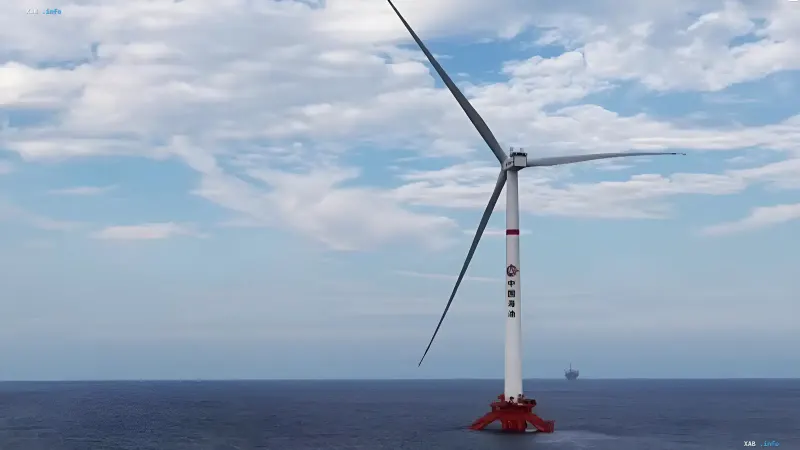
On August 9, 2026, the Chinese energy sector marked a historic milestone. The state-owned China National Offshore Oil Corporation (CNOOC) officially commissioned the country's first floating wind farm utilizing a Tension Leg Platform (TLP). The installation, named Haiyou Anlan, has already been connected to the power grid of the Lufeng offshore oil field and has begun supplying electricity. This project marks the transition from experimental models to the industrial implementation of deep-water wind energy in China.
Technological Breakthrough 136 km Offshore
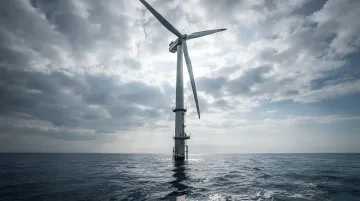
The geographical location of the Haiyou Anlan installation is a record in itself. The platform is located in the South China Sea, approximately 136 kilometers from the coast and at a depth of about 136 meters. This is roughly 200 km southeast of the megacity of Shenzhen. The choice of such a remote and deep-water site is not accidental: here the winds are stronger and more stable, while the construction of traditional seabed foundations becomes economically and technically unfeasible. According to CNOOC, Haiyou Anlan has become the world's largest floating wind turbine of the TLP type in terms of single-turbine capacity.
Gigantic Scale and Typhoon Resistance
The turbine's design is impressive in its dimensions. The height of the entire installation is comparable to a 110-story skyscraper, and its total mass reaches about 7,800 tons. The rotor diameter of the turbine is so large that the area it covers during rotation is comparable to 7.5 football fields. The 16 MW turbine is designed for 25 years of operation. Special attention was paid to survivability in extreme weather conditions of the region: the platform is capable of withstanding Category 17 typhoons, which is a critical parameter for the waters of the South China Sea.
Innovative TLP Platform
The main engineering feature of the project is the use of a TLP. Unlike conventional offshore wind turbines rigidly fixed to a massive foundation, or semi-submersible platforms that can drift, the TLP remains floating but is rigidly fixed in the vertical plane. The structure is held by nearly vertical tensioned tethers connected to anchors on the seabed. The constant tension of these tethers limits the movement of the platform under the influence of waves and currents, ensuring high stability with a minimal footprint. This allows for a significant reduction in steel consumption and the area occupied in the water.
Economic Impact and Ecology
Once reaching rated capacity, Haiyou Anlan is expected to produce about 54 million kWh of electricity per year. All generation is used directly at the Lufeng oil field, powering drilling operations and the platform's life support. According to CNOOC estimates, this will allow for annual savings of about 15,000 cubic meters of diesel fuel, which was previously used by generators at the field. In ecological terms, the project will reduce carbon dioxide emissions by approximately 35,000 tons annually, aligning with China's carbon neutrality goals.
Installation Challenges and the Future of Deep-Water Energy
The installation of the TLP platform proved to be significantly more complex than traditional offshore platforms. It required special precision in anchor installation and the connection of underwater elements. For the construction of Haiyou Anlan, CNOOC developed its own mooring system and high-precision seabed fixing technologies. During underwater installation, engineers used 3D modeling of sea conditions, which, according to the company, allowed connections to be made with millimeter precision. The project is viewed as a testbed for future deep-water wind farms. For China, this is particularly relevant as it allows for electricity production near industrial centers in the east, without relying on energy transmission from the western part of the country.