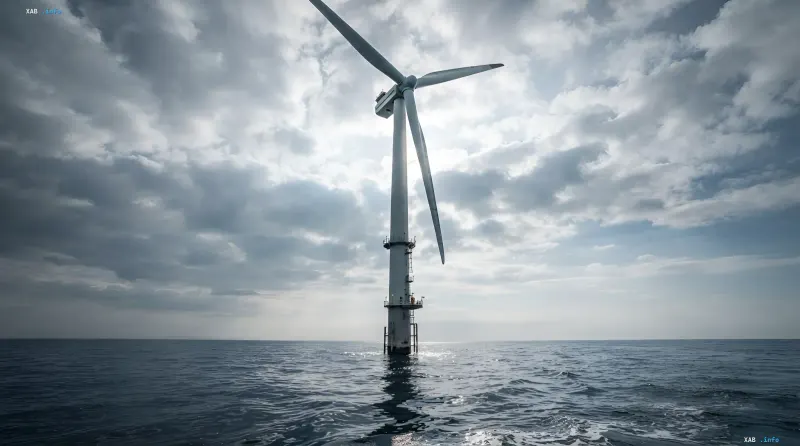
China continues to strengthen its position as a global leader in renewable energy by officially commissioning the country's first large-scale offshore wind farm utilizing next-generation ultra-powerful turbines. The Fanshi project is located in the waters of the South China Sea, approximately 81 kilometers off the coast of Yangjiang city in Guangdong province. The new offshore power plant is designed to provide stable and clean electricity supplies to the strategically important Greater Bay Area, encompassing Guangdong, Hong Kong, and Macao.
Technological Breakthrough and Scale of the Wind Farm
The construction and operation of this unique facility were handled by China General Nuclear Power Corporation (CGN). The overall configuration of the Fanshi wind farm includes 131 offshore wind turbines of varying capacity, most notably 33 ultra-powerful 18-megawatt class turbines. According to official company data, this is currently the world's largest operating cluster of offshore generators with such high single-unit capacity connected to a single power grid.
Engineering Characteristics of the Giant Turbines
The technical parameters of the 18-megawatt units are staggering to engineers worldwide. The working rotor diameter of these giants reaches 292 meters, and the total area swept by the giant blades during rotation is approximately 66,000 square meters—comparable to nine standard football fields. Due to these dimensions, when operating at full capacity, just a single full rotation of the rotor is capable of generating about 43 kWh of electricity—an amount that, according to CGN estimates, is enough to supply an average household for roughly nine days of normal consumption.
Environmental and Economic Impact
Factory calculations show that a single 18-megawatt turbine can generate up to 56 million kWh of clean energy annually. Increasing the unit capacity of generators is of key practical importance: it significantly reduces the total number of required installations at power plants of comparable capacity. This minimizes interference with the marine ecosystem by reducing the number of foundations on the seabed and shortening the length of underwater cables, while also optimizing the use of the allocated water area.
Significance for China's Power Grid
The impressive metrics of the entire Fanshi wind farm are designed for an annual supply of over 6.6 billion kWh of clean electricity to the main power grid. According to CGN calculations, this generation volume will save about 1.92 million tons of standard coal annually and prevent the emission of approximately 5.1 million tons of CO2. Notably, by the end of August 2026, China's installed wind power capacity reached 693 GW, an annual increase of 19.6%, while the country accounted for 78% of new offshore wind capacities connected to grids worldwide in 2025.