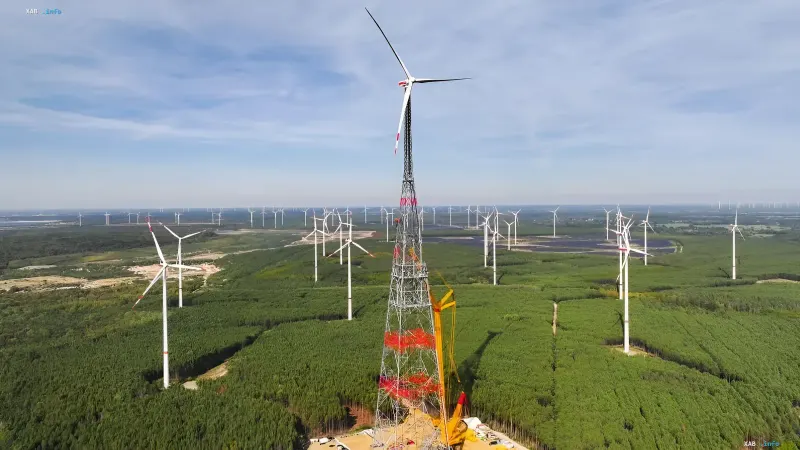
Construction of the world's tallest wind turbine has been completed in Schipkau, Germany, establishing brand-new benchmarks in the renewable energy sector. The innovative GICON installation is striking in its dimensions, with its total height including the rotor blades reaching a record-breaking 365 meters. Meanwhile, the rotor hub is positioned at a dizzying mark of 300 meters above the ground. Due to these monumental dimensions, the giant structure has become the second-tallest building in all of Germany, second only to the famous Berlin TV Tower. The official commissioning of this unique facility into commercial operation is scheduled for November of this current year, immediately following the completion of the final technical work phases and inspections.
Advantages of High-Altitude Wind Energy
The primary engineering concept behind such a colossal structure is gaining access to stronger, more powerful, and much more stable air currents at elevated heights. According to detailed calculations by developers from GICON, a wind turbine featuring a comparable rotor diameter is capable of generating approximately twice as much useful electrical energy compared to conventional onshore installations. The pilot facility has a rated electrical output of 3.8 MW, however, engineers plan to develop serial commercial versions whose capacity will exceed 7 MW. It is important to note that this twofold increase refers specifically to the overall long-term potential energy output rather than instant nominal generator ratings.
Innovative Installation Methods and Prospects
Special attention is deserved by the unique construction technology employed to erect this giant. Instead of utilizing bulky and expensive ultra-high cranes, builders deployed a special telescopic design mechanism. The innovative lifting system carefully extended the inner tower section directly inside a robust lattice structure, after which the element was securely locked at the targeted design height. Additionally, GICON together with the German federal agency SPRIND is actively developing the concept of placing similar high-altitude turbines directly above existing wind farms to optimize spatial footprint.
Controversial Data
Despite the ambition of the project, certain discussions and reservations surround its widespread deployment. Preliminary analytical estimates indicate that Germany could theoretically accommodate up to 4,000 similar high-altitude installations within existing wind parks without requiring the development of new land areas. However, critics and independent experts emphasize that these figures remain purely calculated and hypothetical. The pilot facility in Schipkau currently serves as a testing ground, and its actual economic efficiency and real-world energy output figures still need to be verified in rigorous operational conditions.