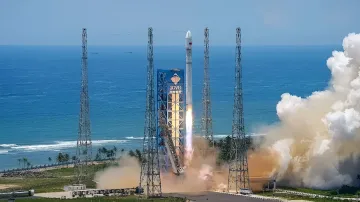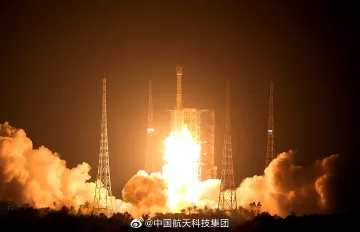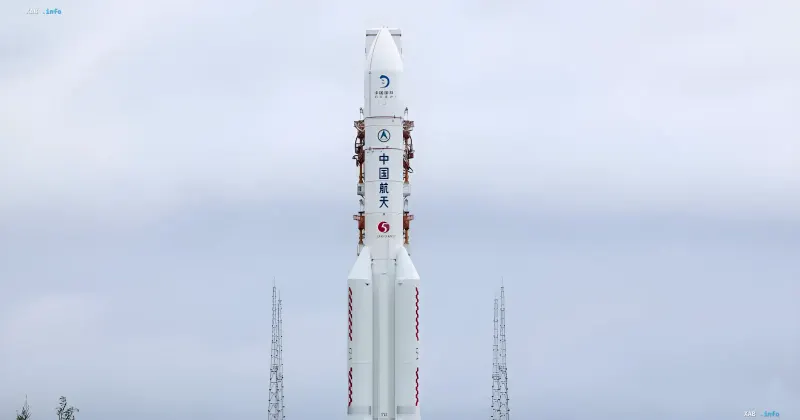
China's lunar research program has undergone an unexpected adjustment: the launch of the automated interplanetary spacecraft 'Chang'e-7' has been postponed. The mission was originally scheduled for the evening of August 23 or the morning of August 24, 2026 (Beijing time), from a spaceport in the southern part of the country, in Hainan Province. By the time official channels were expected to issue clarifications on resuming the launch, the spacecraft had still not left the launch pad, and statements from Chinese authorities did not specify when exactly the mission might be resumed. In photos from the site, the launch vehicle carrying the lunar spacecraft, marked with the logos of China's space agency and the inscription 'China Aerospace,' stood ready for launch against a cloudy sky.
Official version: the spacecraft 'does not yet meet launch conditions'
The exact reason for the delay has not been officially announced. Chinese state media limited themselves to the formulation that 'the lunar probe does not yet meet launch conditions,' adding that the decision to postpone was made 'on the basis of the principles of caution, reliability, and ensuring the absolute success of the mission.' Such language is characteristic of Beijing's space bureaucracy: it records the fact of the postponement but discloses neither the technical nor the organizational nature of the failures, leaving room for internal refinements without public discussion.
Partner from Thailand: launch expected next year, likely cause — weather
A more concrete picture was painted by Wipha Rujopakarn, director-general of Thailand's National Astronomical Research Institute (NARIT), who told CNN on August 24 that the launch of 'Chang'e-7' is now expected next year — possibly in spring or mid-summer. According to him, information about the mission came directly from China, since NARIT is one of seven international partners that prepared research equipment for integration into the probe. Wipha explained the lengthy delay by the technical complexity and unprecedented nature of the mission: the probe had to reach a precisely defined orbit in order to then make a landing in an optimal location on the Moon. He cited, most likely, weather as the main reason for the postponement, while emphasizing that 'other factors cannot be ruled out.' Among the international scientific payload of the spacecraft, according to Russian sources, is also an instrument for studying lunar dust, which underscores the multinational nature of the mission's payload.
What 'Chang'e-7' was supposed to do
The 'Chang'e-7' mission was regarded as the world's first attempt at direct, rather than remote, analysis of water on the Moon. The complex plan included a robot that was to separate from the landing module, move to impact craters in the region of the Moon's South Pole, and drill boreholes to extract ice. This fundamentally distinguishes the task from what the United States has managed to do: American satellites detected ice reserves and began assessing their size using remote sensing methods, but Washington has so far failed to successfully send a spacecraft for drilling and direct development of this resource. The success of the Chinese mission could have become a turning point in the race for lunar water resources.
Contradictory data
Notable discrepancies are observed in the public statements of the parties. First, Chinese state media reduce the postponement to the general formula 'does not meet launch conditions' and 'principles of caution,' naming no specific reason, whereas the Thai partner NARIT directly points to weather as the likely main cause and to the technical complexity of the orbital maneuver. Second, the original launch window (August 23–24, 2026) has in effect been replaced by the estimate 'next year, spring or mid-summer,' but this new chronology has not been officially confirmed and relies on the words of one of the partners rather than on a statement from the Chinese space agency. Thus, the fact of canceling the launch on the original dates is confirmed, while the reasons for the delay and the new timelines remain officially unconfirmed and allow for various interpretations.