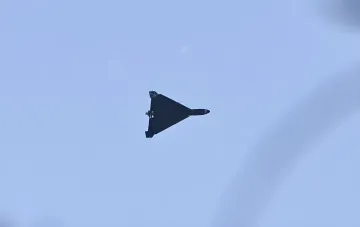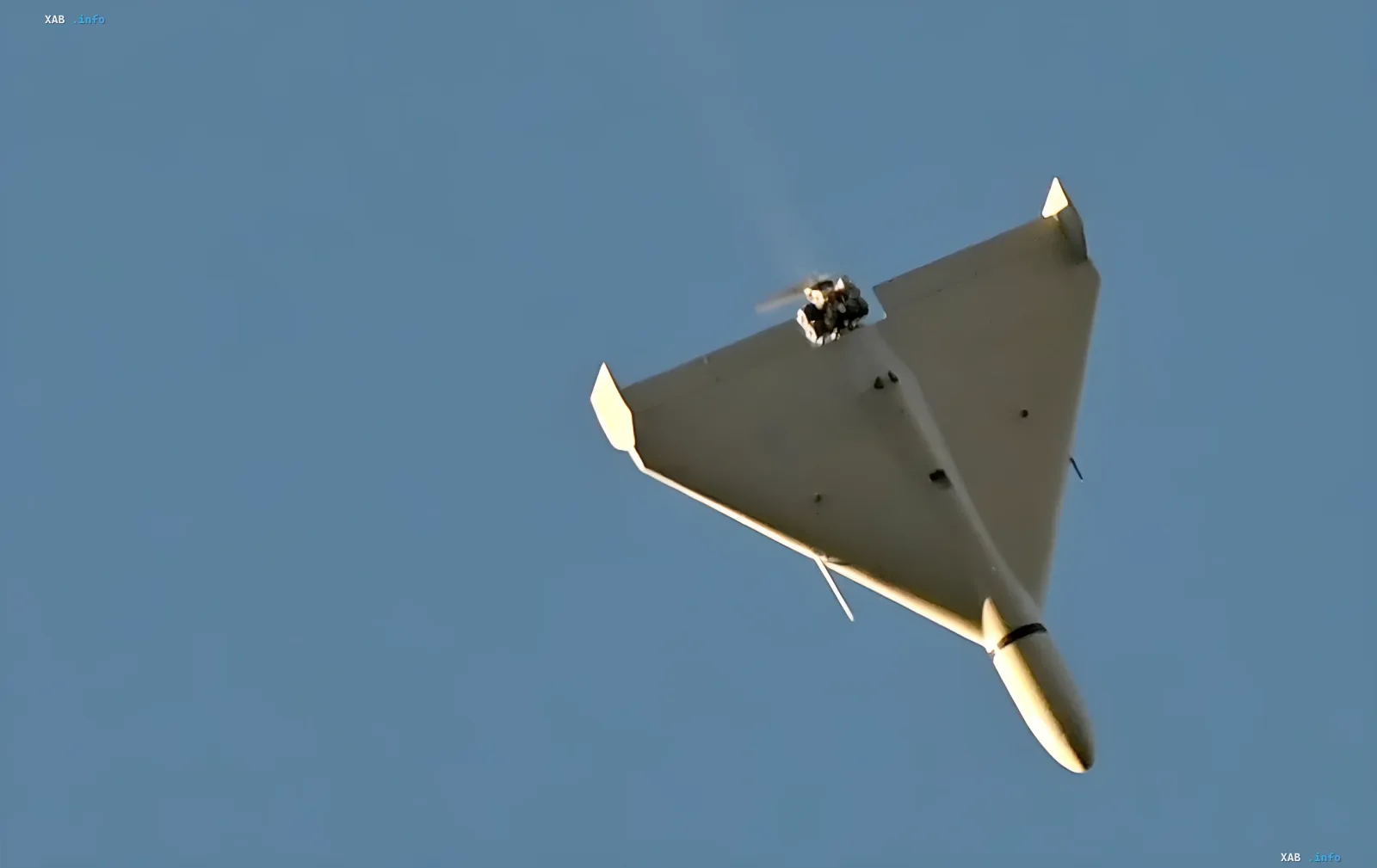
Russia has begun using a new modification of the "Shahed" strike drone, equipped with a jet engine, in mass attacks on Ukraine. According to The Wall Street Journal, as cited by RBC-Ukraine, such drones are capable of reaching speeds of up to 500 km/h — roughly three times faster than previous versions. This fundamentally changes attack tactics: the interception window shrinks, while the approach radius and speed toward the target increase. According to the publication's assessment, the emergence of this modification was made possible to a large extent thanks to the Chinese side, whose enterprises supplied engines and other key components.
Three Times Faster Than Before
The main quantitative difference of the new version is speed. If classic "Shaheds" flew at around a hundred-something kilometers per hour, the jet modification, according to WSJ data, reaches 500 km/h. For air defense systems and operators, this means a several-fold reduction in the time available for detection, tracking, and the decision to intercept. This is precisely why the appearance of jet drones is regarded as a significant escalation in the arsenal Russia uses to carry out mass attacks on Ukrainian infrastructure and cities.
The Chinese Supply Chain as the Foundation
According to current and former US officials, Beijing has for a long time remained the main source of components for "Shaheds." This includes, in particular, servomotors and gyroscopes — parts without which flight control and stabilization are impossible. WSJ emphasizes that it was precisely thanks to this international supply chain that Iran managed to establish the production of inexpensive strike drones, which Russia subsequently began using massively against Ukraine. Thus, the end user and the manufacturer are formally separated, while the critical role is played by a third participant — the component supplier.
The German Engine as the Technical Basis
One of the main technical challenges for Iranian engineers was creating an engine capable of operating for hours at high speeds and significant temperatures. They based it on the German L 550 E engine produced by Limbach Flugmotoren. According to the publication, in 2012 a Chinese company began selling Limbach engines, and in 2017 it fully acquired the German manufacturer. This simplified Iran's access to such power units. Subsequently, Iran created its own version of the engine based on Limbach models, but used cheap Chinese components in the process, which allowed it to keep the unit cost of serial machines low.
The Telefly Trail
Separately, WSJ mentions the Chinese company Telefly Telecommunications Equipment. Ukrainian authorities stated that it manufactures turbojet engines. After Kyiv reported the discovery of Telefly engines in Russian drones, information about turbojet units disappeared from the English-language version of the company's website. At the same time, the corresponding mentions remained on the Chinese-language and other language versions of the site, as well as on the pages of other Chinese online sellers, which, in effect, confirms the presence of such a direction in the product line.
Contradictory Data
It is important here to honestly reflect the discrepancy in assessments. On the one hand, WSJ and the Ukrainian media citing it paint a picture of a serious qualitative leap: speed up to 500 km/h, a threefold advantage over previous modifications, and China's key role in creating this threat. On the other hand, a Ukrainian analytical review (Focus) characterizes the jet "Shahed" as a "fast but not long-range" aircraft that, in the authors' view, possesses no special characteristics placing it beyond the already known class of drones. In other words, the fact of the existence of a jet modification and its increased speed is confirmed, but the degree of its tactical impact and its actual combat capabilities are assessed differently. Additionally: the disappearance of mentions of turbojet engines only from the English-language version of the Telefly website is an indirect, not a direct evidentiary argument, and its weight in fact assessment is limited.
The Diplomatic Context
The technical story unfolds against the backdrop of diplomatic pressure on China. Recently, Ukrainian President Volodymyr Zelenskyy called on Beijing to "cool down" Putin's enthusiasm after new threats. Meanwhile, it became known that China demanded that Russia and Ukraine cease hostilities. These statements form the political backdrop against which the role of Chinese components in the production of weapons used in the conflict is discussed.