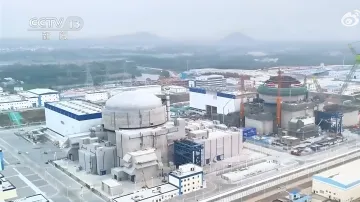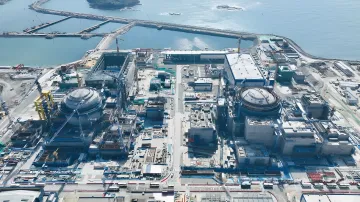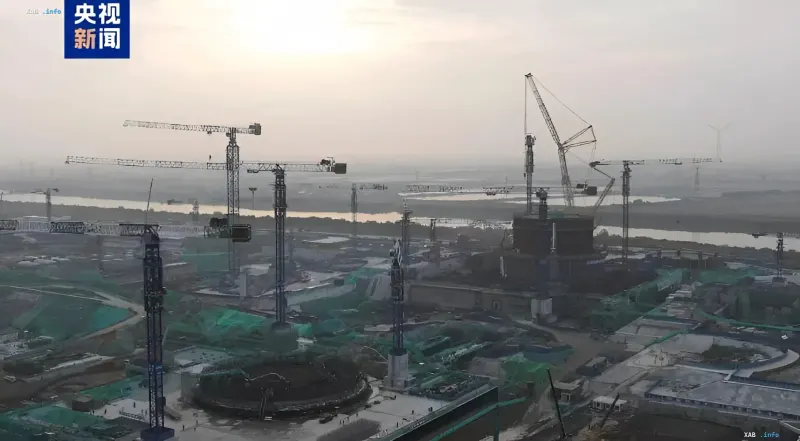
At the Zhangzhou Nuclear Power Plant construction site in Fujian Province, the installation of three steam generators for the fourth power unit, equipped with a Hualong One reactor, has been completed. This was reported by the state agency Xinhua. The equipment was lifted and installed into its design position with high precision, marking the final stage of preparing the reactor hall for subsequent commissioning work. Images broadcasted by CCTV News show a large-scale construction complex: dozens of tower cranes, the already erected cylindrical hull of the reactor building, and a vast territory covered with protective green netting.
Steam Generators — The 'Lungs' of the Nuclear Power Plant
The installed ZH-65 brand steam generators are among the key elements of the power unit. During operation, they transfer heat from the primary coolant circuit to the water of the secondary circuit, turning it into steam, which drives the turbine generator and generates electricity. In addition to their primary function, steam generators act as a physical barrier between the reactor's radioactive coolant and the steam circuit, and also participate in removing residual heat from the core after the reactor is shut down. Due to their multifunctionality and critical importance for the station's operation, steam generators are often referred to in the industry as the 'lungs' of the nuclear power plant.
Start of Chilong-1 Construction: A Step Toward Generation IV
Concurrently with the completion of Hualong One units, China is promoting its next-generation reactor program. On November 6, 2026, full-scale construction of the nuclear island for the Chilong-1 reactor — a Generation IV high-temperature gas-cooled reactor — began at the Xuwei NPP site in Jiangsu Province. The launch of construction work on the nuclear island is traditionally considered a turning point in the nuclear power plant's lifecycle: from this moment, the facility moves from the preparation stage to the active construction phase of the main structures.
Technological Features of Chilong-1
The Chilong-1 reactor uses spherical fuel elements capable of withstanding temperatures up to 1620 °C. Helium is used as a coolant to remove heat from the core. Due to its design features, the reactor is designed for safe dissipation of residual heat even in the event of a complete loss of standard cooling — this is one of the key passive safety indicators embedded in Generation IV designs. In addition to electricity generation, the plant will be able to supply industrial enterprises with high-temperature steam, expanding the scope of nuclear energy applications beyond electricity generation.
Context: Accelerating China's Nuclear Program
The combination of events — the completion of major equipment installation at Zhangzhou and the start of construction of Chilong-1 — demonstrates China's simultaneous work on two technological levels: bringing serial Hualong One units to operation and launching fundamentally new reactor systems. For the industry, this means that by the 2030s, both third- and fourth-generation units may operate simultaneously in China's power system, significantly diversifying the country's nuclear fleet.