China has officially committed to the ambitious goal of landing astronauts on the lunar surface no later than 2030 and presented a detailed schedule for mission preparations. The mission is positioned as a key milestone of the national lunar program and a new step in exploring Earth's satellite. For Beijing, this is not merely a technological task, but part of a long-term strategy for presence in cislunar space.
Mission Architecture Without a Super-Heavy Rocket
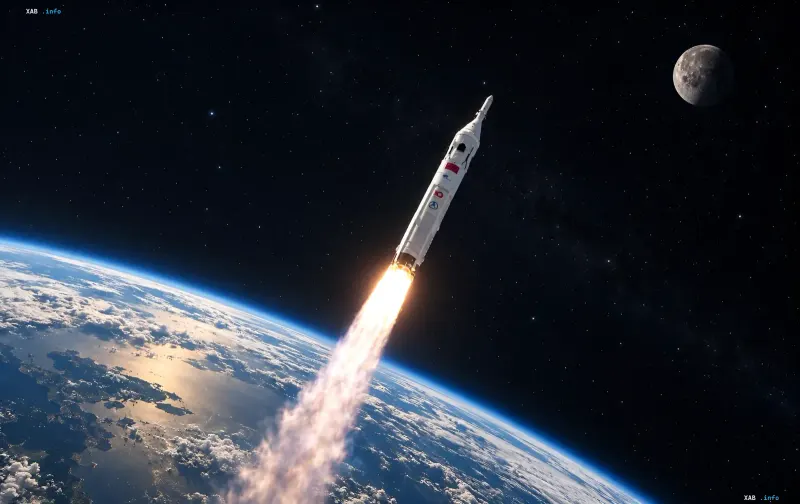
Unlike the US Apollo program, which relied on the Saturn V super-heavy rocket, the Chinese program lacks an equivalent launcher. Therefore, the mission is designed around a split-launch scheme: the crew and the landing module are sent to the Moon via separate launches and then dock in lunar orbit. This approach avoids the need for a single super-heavy vehicle, but raises the requirements for orbital maneuver accuracy and spacecraft autonomy.
Testing and Pace of Progress
China is demonstrating rapid technological progress. In August 2025, the China Manned Space Agency successfully tested a full-scale mockup of the Lanyue landing module near Beijing, and the first test spacecraft has already been delivered to the Wenchang spaceport. Meanwhile, the Mengzhou crewed spacecraft is being tested during missions to the Tiangong space station. Notably, unlike the US, the Chinese plan does not currently include preliminary crewed lunar flyby missions without landing.
The American Context: Artemis Challenges
Meanwhile, the US Artemis program is facing its own difficulties. A key risk factor is the reliance on private companies SpaceX and Blue Origin for the development of lunar landing modules. These delays and organizational hurdles create a window of opportunity where China could outpace the US in landing timelines if it maintains its current preparation pace.
Geopolitics and the South Pole Perspective
Both nations view the current standoff as a geopolitical struggle for influence in cislunar space. At the same time, Beijing and Washington are already preparing for the next phase: establishing long-term bases near the Moon's South Pole, where reserves of water ice are concentrated, which are critical for a long-term presence and future energy infrastructure. Thus, the competition extends far beyond a single landing, transforming into a race for infrastructure.
Consequently, by 2030 China intends to turn the lunar landing from a declarative goal into a realized stage, relying on the split-mission architecture and already initiated testing of key vehicles. The outcome of this phase will largely determine the balance of power in the lunar program for the next decade.