China has for the first time published a detailed multi-year schedule for preparations leading up to a crewed lunar landing. Wang Xiang, chief designer of the national lunar program, presented the roadmap at the Seventh Symposium on Manned Spaceflight in Beijing. According to the disclosed materials, before sending taikonauts to the lunar surface, Beijing will conduct a comprehensive uncrewed 'dress rehearsal' to test the entire flight profile—from spacecraft docking with the lunar lander in lunar orbit to descending to the surface and returning to orbit. Only after the successful completion of all tests does China plan to execute the crewed landing no later than 2030.
Three Steps of the 'Dress Rehearsal'
The uncrewed testing phase is divided into several independent missions. In the first stage, China will test the 'Mengzhou' crewed spacecraft in low-Earth orbit, verifying its life support, navigation, and control systems under conditions closely resembling an actual flight. In the second stage, the 'Lanyue' lunar lander will be sent into space to execute a landing on the Moon and a subsequent ascent from its surface. The final, third stage in 2029 will feature a joint uncrewed flight of both vehicles and their docking in lunar orbit—an exact simulation of the scenario that will later be performed with a crew on board.
Two Rockets and No 'Flyby Without Landing'
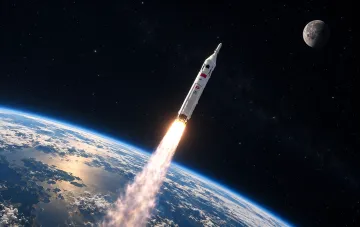
The crewed expedition itself will utilize two Long March-10 rockets: one to deliver the 'Mengzhou' spacecraft with taikonauts to lunar orbit, and the other to deliver the 'Lanyue' lander. Notably, the Chinese plan lacks a separate mission analogous to the American Apollo 8 or Artemis II, in which the crew first performs a lunar flyby without landing. Chinese engineers intend to validate the 'Mengzhou' through closer-to-Earth crewed flights, including delivering taikonauts to the Tiangong space station, considering these tests sufficient validation of the spacecraft prior to the lunar flight.
Testing Already Underway: Lanyue Mockup and Spacecraft at the Spaceport
Program preparations have entered a practical phase. In August 2025, specialists successfully tested a full-scale 26-metric-ton mockup of the 'Lanyue' lander: special cables were used to simulate lunar gravity while engines and control systems practiced landing and ascent maneuvers. Additionally, the 'Mengzhou' spacecraft intended for the 2027 tests has already been delivered to the Wenchang spaceport on Hainan Island, confirming that the stated hardware preparation schedules are being met.
The Race with Artemis: Who Will Be First
The published schedule allows for a direct comparison between Chinese plans and the American Artemis program. NASA is targeting a crewed lunar landing in 2028, but the development of the human landing system by SpaceX and Blue Origin remains a major source of uncertainty, with delays potentially pushing the U.S. mission to 2030 or even later. Thus, if the stated timelines are maintained, China has a real chance to return humans to the Moon ahead of the United States. At the same time, Beijing's goal is not limited to a single landing, but rather establishing the technical foundation for a more prolonged human presence on the Moon in the future.