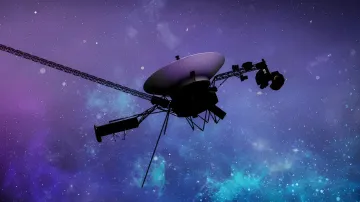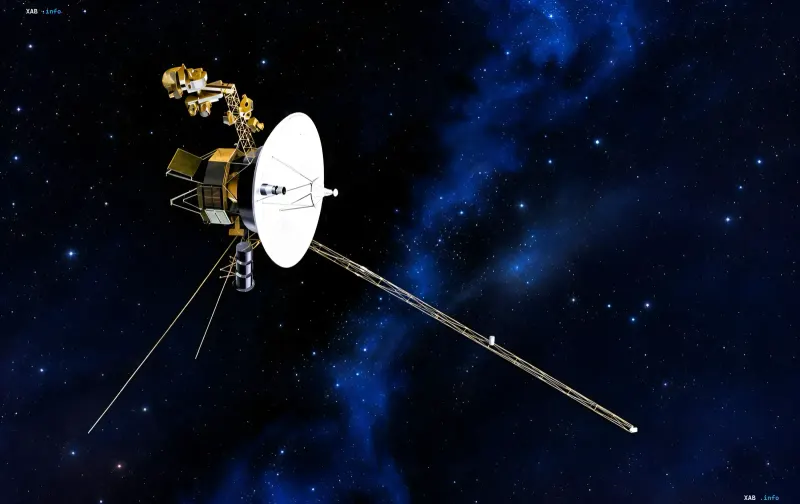
On November 18, 2026, NASA’s Voyager 1 spacecraft will achieve a milestone no human-made object has ever reached: it will be one light-day away from Earth — nearly 25.9 billion kilometers. For a mission originally designed for just five years of operation, this marks a new historic milestone. Despite its advanced age and the steady decline in power from its plutonium generator, Voyager 1 continues to transmit scientific data from the edges of the solar system, remaining humanity’s most distant active spacecraft.
One light-day: what it means in practice
According to scientists, a distance of one light-day is 173 times the distance between the Earth and the Sun. This means that a radio signal sent from Earth will take exactly 24 hours to reach the probe one-way, and a response will take another full day to return. Even a simple exchange of information between the mission on Earth and the probe now requires at least 48 hours. For engineers, this means that every decision and every command requires pre-calculated, essentially “one-shot” precision — correcting an error in real-time is no longer possible.
The craft that was supposed to “die” in five years
Voyager 1 was designed as a short-term mission, yet its construction and energy management have allowed it to operate for decades longer than planned. The primary constraint today is the gradual depletion of energy from the plutonium radioisotope generator. Because of this, specialists have to turn off scientific instruments one by one to preserve the craft's core functions and communication with Earth. Nevertheless, Voyager 1 continues to transmit scientific data, remaining an active participant in interstellar exploration.
Glitch and reconnection
In recent years, the mission has faced multiple technical challenges, which NASA engineers have successfully resolved from billions of kilometers away. In November 2023, the team addressed a memory glitch, restoring the functionality of onboard systems. In October 2026, communication with the craft was re-established after a two-day break. Both episodes confirm that even at such a distance, the mission remains controllable, albeit with a full-day delay for every signal.
The energy ceiling and extending instrument life
A key challenge for the mission remains the energy deficit. Thanks to a recent resource-saving operation, NASA engineers managed to keep the craft’s last three active scientific instruments running for at least another year. This decision was a compromise between the scientific value of the data and the necessity to extend the overall life of the mission as generator power levels continue to dwindle.
Voyager 2: the twin with a different schedule
Meanwhile, the program's second craft, Voyager 2, launched 16 days earlier than its “twin,” also continues to operate in interstellar space at a distance of more than 20.9 billion kilometers from Earth. However, due to trajectory differences, it will reach the one light-day distance later than its predecessor — only in 2035. Thus, Voyager 1 will retain its status as the most distant human-made object at least until the middle of the next decade.