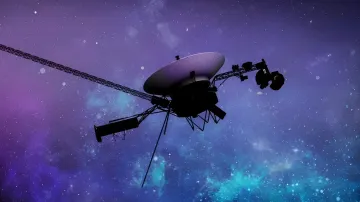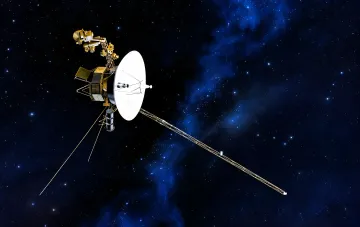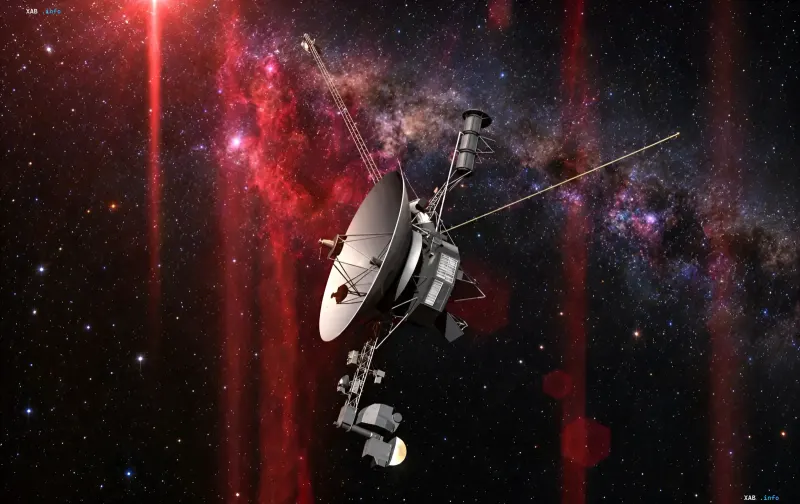
On November 18, 2026, one of the farthest objects ever created by humanity crossed a symbolic milestone: the Voyager 1 spacecraft reached a distance of one light-day from Earth. This is more than 25 billion kilometers—a distance that a beam of light travels in exactly 24 hours. To reach this point, the probe, launched in 1977, took nearly half a century of continuous flight at an average speed of about 61,000 kilometers per hour. Now, a radio signal from Earth to the craft and back takes a full day, and a complete data exchange cycle—sending a command and receiving confirmation—stretches to 48 hours.
Celebrating the Milestone: Morse Code Signals
NASA has decided to mark this historic milestone in an unusual way: the agency invited mission fans to send signals to the sky using Morse code. The initiative emphasizes that, despite the colossal distance, the craft remains part of an active scientific program. However, at such a distance, any real-time external intervention is impossible: the probe relies on its own safety algorithms. This was proven in practice—in October 2026, contact with the craft was interrupted for two days due to the triggering of automatic protection, which mission engineers subsequently diagnosed and resolved.
Why Voyager 2 Lags Behind by Nearly a Decade
A logical question arises: why will the mission's second craft, Voyager 2, reach the same distance only after nearly ten years, even though both probes launched in 1977 with only a two-week gap? The paradox is that Voyager 2 was actually the first to be launched into space, yet its sibling eventually overtook it and is currently moving away from the Sun faster. The reason lies in the different routes chosen by NASA based on the scientific goals of each craft. Voyager 1 was placed on a faster trajectory: it reached Jupiter on March 5, 1979, four months before Voyager 2, then flew past Saturn to study its rings and its largest moon, Titan, before leaving the Solar System while moving upward and outward. It is currently covering approximately 3.5 astronomical units per year.
The Gravitational "Slingshot" and Its Cost
Voyager 2 was given a different task: to take advantage of a rare planetary alignment to explore not just Jupiter and Saturn, but also Uranus and Neptune. During the flybys, both probes used a gravity assist—a kind of cosmic "slingshot" where the planet's gravity changed the direction of movement and gave the craft additional speed. At Jupiter, each probe accelerated by about 10 km/s, and Voyager 2 additionally gained about 5 km/s at Saturn and another 2 km/s at Uranus. However, when flying past Neptune, the craft sharply changed its trajectory to study its moon, Triton: it passed over the planet's north pole and dropped below the Solar System plane, losing about 2 km/s. As a result, Voyager 2 is moving slower—approximately 3.1 astronomical units per year.
Operating Longer Than Predicted
Despite the difference in speed, both craft successfully entered interstellar space: Voyager 1 in 2012, and Voyager 2 in 2018. Reaching the one-light-day milestone means the probes have been operating significantly longer than anyone predicted nearly 50 years ago. The NASA Jet Propulsion Laboratory (JPL), which manages the project, still maintains their operations, although nuclear power sources are gradually depleting. To extend the lifespan of the only interstellar craft in history, engineers have been gradually turning off unnecessary scientific instruments and performed an energy redistribution procedure known as "Big Bang." Thanks to these measures, both craft have every chance of continuing to operate well into the 2030s.