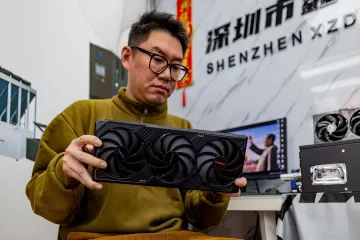
Chinese telecommunications operator China Telecom has announced the completion of training for the open AI model Xing4.1-Preview, which combines 285 billion parameters and is designed for programming, complex reasoning, and autonomous AI agent tasks. The model was trained entirely on domestic computing infrastructure, utilizing a cluster of 8,192 Huawei Ascend 910C accelerators, with the Chinese MindSpore framework serving as the software backbone. The model's context window reaches one million tokens, allowing it to process voluminous documents, long reasoning chains, and multi-step agent scenarios without loss of coherence.
MoE Architecture and Efficient Attention Mechanisms
Xing4.1-Preview is built on a Mixture of Experts (MoE) architecture. Out of 285 billion parameters, only 17 billion are activated during the processing of each token, maintaining computational efficiency comparable to a significantly smaller model while preserving the knowledge capacity characteristic of a large parameter space. The architecture also incorporates two specialized attention mechanisms: Multi-head Latent Attention (MLA) and DeepSeek Sparse Attention (DSA). Both aim to reduce the computational cost of processing long sequences, which is critical for the stated one-million-token context window.
Training on 8,192 Huawei Accelerators
The entire pre-training cycle of the model took place on a cluster of 8,192 Huawei Ascend 910C accelerators, making Xing4.1-Preview one of the largest projects implemented exclusively on Chinese hardware. To ensure the stability and throughput of such a cluster, China Telecom applied its own parameter distribution strategy across compute groups, alongside various optimizations aimed at memory management and data exchange between accelerators. Long-sequence processing was optimized separately, fitting within the limited resources of each chip while handling a one-million-token context. Following pre-training, the model underwent post-training on TeleGym, a specialized environment for training and evaluating AI agents.
Vocabulary Adaptation for Code and Agent Scenarios
China Telecom developers purposefully adapted the model's tokenizer for programming domains and agent work. Large volumes of program code, AI agent action sequences, and external tool calls were analyzed. According to the company, this tuning reduced the token count by 23% when processing program code and by 16% in agent scenarios while maintaining the total vocabulary size. This means the model "reads" code and action chains more efficiently, directly impacting inference speed and maintenance costs.
Benchmark Results: Strengths and Growth Areas
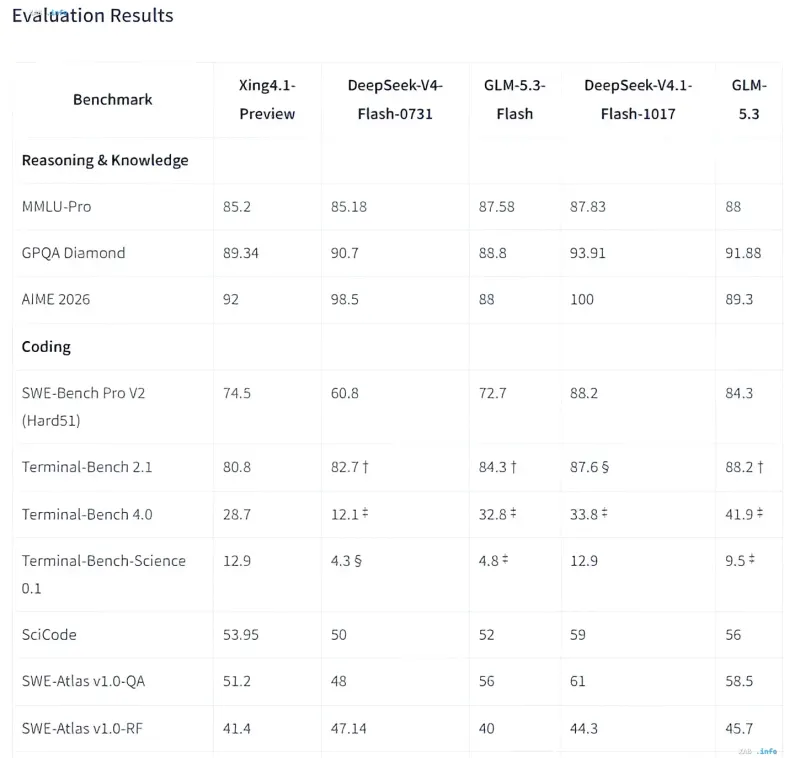
China Telecom published a comparative table of Xing4.1-Preview results alongside several competing models, including DeepSeek-V4-Flash-0731, GLM-5.3-Flash, DeepSeek-V4.1-Flash-1017, and GLM-5.3. In the reasoning and knowledge section, the model scores 85.2 on MMLU-Pro, 89.34 on GPQA Diamond, and 92 on AIME 2026. The latter result places Xing4.1-Preview second in the table, trailing only DeepSeek-V4.1-Flash-1017 (100 points) and outperforming GLM-5.3 (89.3). In coding, the picture is mixed: on SWE-Bench Pro V2 (Hard51), the model scores 74.5, outperforming DeepSeek-V4-Flash-0731 (60.8) and GLM-5.3-Flash (72.7), but trailing DeepSeek-V4.1-Flash-1017 (88.2) and GLM-5.3 (84.3). On Terminal-Bench 2.1, the score is 80.8, while Terminal-Bench 4.0 yields 28.7, the lowest value in the table. On SciCode, Xing4.1-Preview scores 53.95, behind DeepSeek-V4.1-Flash-1017 (59) and GLM-5.3 (56). Thus, the model demonstrates competitive results in mathematical and general reasoning, as well as SWE-Bench-level engineering tasks, while lag in terminal and scientific benchmarks indicates areas requiring further refinement.
Open Weights and Ecosystem Compatibility
Xing4.1-Preview weights are available in PyTorch format, allowing developers to use the model outside the original MindSpore infrastructure. Deployment compatibility is provided for popular inference tools vLLM and SGLang. This means Xing4.1-Preview can be integrated into existing production pipelines without rebuilding for a specific Chinese stack, expanding the pool of potential users beyond the Chinese market.