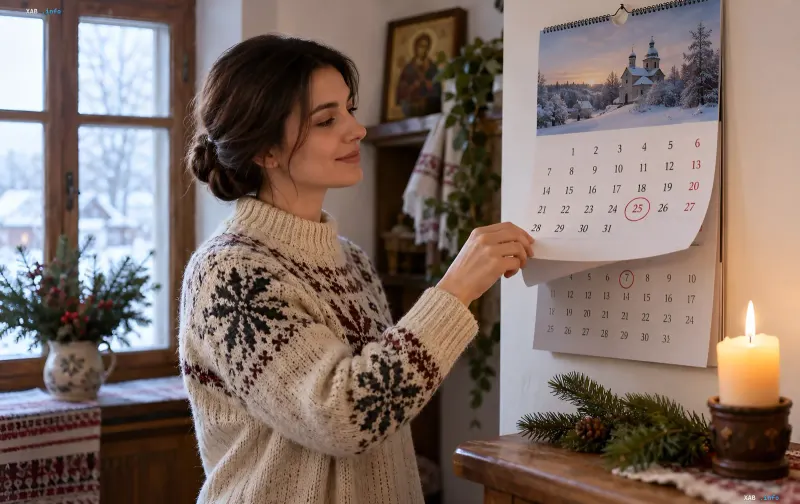
Previously, Ukrainians traditionally celebrated Christmas after the New Year in January. However, following the church calendar reform, the date of the holiday has noticeably changed, moving to December. This has become an important step in the cultural and spiritual life of the country, bringing Ukrainian traditions closer to pan-European standards of celebrating major religious dates.
Transition to the Revised Julian Calendar
The main benchmark for all believers throughout the year is the current church calendar. It outlines the days when the memory of saints is honored and major holidays are indicated. Previously, the Orthodox Church of Ukraine followed the Julian calendar, according to which Christmas fell on January 7. However, in 2023, the OCU officially switched to the revised Julian calendar, shifting all fixed holidays 13 days earlier.
Legislative Changes and State Recognition
In the summer of 2023, the Verkhovna Rada of Ukraine adopted Law No. 3258-IX amending the Labor Code. The document, signed by President Volodymyr Zelenskyy, officially established new dates for public holidays in accordance with the revised Julian calendar. Thus, the official celebration of Christmas in Ukraine was finally moved to December 25, and Christmas Eve is now celebrated on December 24.
Contradictory Data
Despite the official transition to the new calendar and state changes, discussions remain around celebration practices. Archpriest George Kovalenko, rector of the Open Orthodox University, explained that the church legally does not prohibit individual communities or believers from living by the old calendar if they wish. At the same time, clergymen emphasize that an orthodox Christian should not celebrate Christmas twice — both on December 25 and January 7, because church life is built on a holistic annual cycle rather than duplicating dates.
Significance of the Reform for Society
The transition to the new calendar caused widespread public resonance and discussions among believers. According to OCU representatives, the adaptation process in various regions went differently, but most parishes successfully integrated into the new calendar system. This transformation also affected related traditions, including the Nativity Fast, which now also begins and ends two weeks earlier than under the old style.