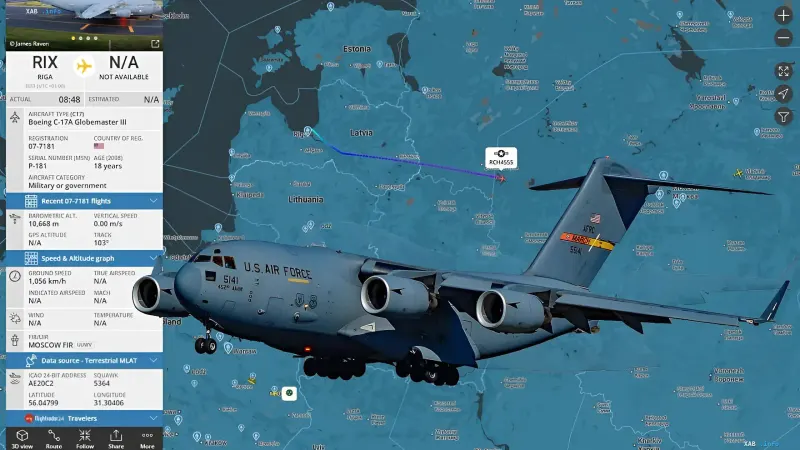
Early Tuesday morning, August 25, 2026, a heavy U.S. Air Force C-17A Globemaster III military transport aircraft landed at Moscow's Vnukovo Airport. Aboard was Director of Central Intelligence John Ratcliffe. This was reported by leading CBS News reporters Olivia Gazis and Jim LaPorta, citing sources in intelligence circles. Neither the White House nor the Kremlin officially announced the visit: immediately after landing, the U.S. delegation headed to a series of closed, high-level meetings with Russian officials. According to specialized monitoring channels tracking military aviation, the aircraft has been confirmed by tail number and route — this is not a civilian jet, but specialized transport traditionally used to move top Pentagon and intelligence officials on protected missions.
Special flight to Vnukovo: how the "shadow" communication channel works
The format of the visit speaks for itself. The C-17A Globemaster III is a four-engine long-range military transport aircraft capable of delivering a large delegation with a full communications and security package to any point on the planet. Its choice over a private jet or the government Boeing 747-200B (Air Force One) indicates that the mission was of an operational intelligence nature, rather than protocol diplomacy. Landing at Vnukovo's government terminal, rather than Sheremetyevo, further confirms the closed nature of the meeting: it is precisely this terminal that services delegations whose visits do not appear in public schedules. According to CBS News, Ratcliffe arrived accompanied by a limited number of CIA staff, not a full diplomatic mission — a classic "small group" scheme for director-level intelligence talks.
Background: from a March 2025 phone call to a personal flight
This is not the first contact between Washington and Moscow at the intelligence-service level since Donald Trump's return to the White House in 2025. As early as March 2025, John Ratcliffe held the first direct phone talks in two years with the head of the Russian Foreign Intelligence Service (SVR), Sergey Naryshkin. At that time, the sides agreed to maintain a regular communication channel for "de-escalation of confrontation" — a formulation that in intelligence practice means establishing a "hotline" for emergency signals. However, Ratcliffe's current personal flight to Moscow takes this closed dialogue to a fundamentally new level: from phone signals to face-to-face negotiations, where the discussion is not about individual incidents but about strategic outlines. According to news agencies, this is the first personal visit by the CIA Director to Russia since the start of the special military operation.
Three scenarios: what is being discussed behind closed doors at Vnukovo
Official bodies on both sides are keeping silent, however, analysts, relying on the context of recent months, identify three key tracks most likely to feature on the agenda of the closed meetings. The first, and probably the main one, is freezing the war in Ukraine and the outlines of new negotiations. The Trump administration had previously sharply restricted intelligence sharing with Kyiv and blocked parts of military aid packages. In this logic, Ratcliffe may have brought specific Washington "red lines" and final U.S. demands on fixing the front line — that is, not simply to "discuss" but to present a ready-made negotiating framework. The second track is a prisoner exchange. The CIA has traditionally been the main operator of large deals on exchanging detained persons between Russia and the U.S., as was the case under William Burns. Against the backdrop of accumulating new arrests on both sides, this track always requires the personal presence of the heads of the agencies: such details cannot be coordinated by phone. The third scenario is the Middle East crisis and Iran. The Middle East war is currently a priority for Washington. The U.S. may be seeking leverage to pressure Tehran through Moscow to prevent a full-scale nuclear or regional crisis, in exchange offering concessions on the European track. It is precisely the combination of these three topics that makes the visit so sensitive that both sides prefer not to publicize it until the negotiations are concluded.
Why this matters: the geopolitical context of the secret visit
The secret arrival of the CIA Director in Moscow amid ongoing conflicts on two continents is not simply "intelligence diplomacy" in the narrow sense. It is a signal that the formal diplomatic channels, which have been frozen or sharply narrowed in recent years, cannot cope with the volume of acute issues requiring immediate resolution. The choice of format — military transport, government terminal, absence of press releases — indicates that the sides are consciously minimizing the public footprint to prevent the leakage of negotiating positions before they are finalized. For observers, this means: in the coming hours and days, sharp shifts in the tone of official Washington and Moscow statements on Ukraine, Iran, and bilateral relations are possible — precisely the topics currently being discussed in the closed halls of Vnukovo.