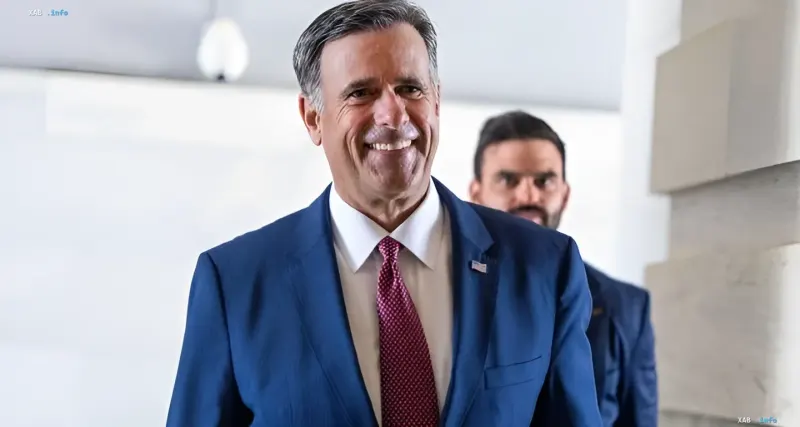
On the morning of August 25, 2026, a US Air Force Boeing C-17A Globemaster III military transport aircraft (tail number RCH4555) landed at Vnukovo Airport in Moscow, arriving from Riga. A US embassy motorcade was spotted at the aircraft. According to reporting by Axios journalist Barak Ravid and CBS News's Jennifer Jacobs, the director of the US Central Intelligence Agency, John Ratcliffe, was on board. The arrival of the CIA chief has been confirmed by objective air traffic monitoring, including data from the Flightradar24 service, and marks the highest-level contact by representatives of the Donald Trump administration in the Russian capital in recent times.
Secret Arrival: What Objective Data Confirms
The visit is of an exclusively closed, intelligence-related nature. Neither the White House nor the Kremlin press service has officially commented on the format or agenda of the trip. Through closed communication channels the day before the delegation's departure, Washington notified Kyiv of the dispatch of a high-level mission to Moscow and made a confidential request — to temporarily suspend drone and long-range weapons strikes on targets in Moscow and its surroundings until the US delegation departs. As Axios sources note, such a measure is necessary to guarantee the physical safety of the head of a key US intelligence agency and to prevent the collapse of the urgently arranged consultations.
Why Washington Asked Kyiv for a 'Silence Mode'
Analysts and subject-matter experts highlight several factors behind the White House's request. First, on the eve of the visit, Ukrainian drones carried out a massive coordinated attack on major logistics complexes in Russia's southern regions, which Washington interpreted as a signal of possible escalation: the US administration feared that the next large-scale target could be Moscow itself. Second, any drone strike on the capital while a US government aircraft or a CIA motorcade was present would have immediately derailed the negotiations, triggered the closure of the capital's air hub under the so-called 'Cover Plan,' and effectively stranded the US special aircraft on the runway. Third, according to sources, Ratcliffe brought to Moscow not public ultimatums but specific technical conditions and the outlines of a future negotiation track on freezing the front line, coordinated with Trump, as well as up-to-date lists for the next phase of prisoner exchanges. Any military force majeure in the skies over Moscow would have wiped out the entire secret round of consultations.
Contradictory Data
It is important to honestly record the discrepancy between versions here. On the one hand, the arrival of the C-17A aircraft at Vnukovo on August 25 is confirmed by independent air traffic monitoring and by two leading US publications (Axios, CBS News). On the other hand, Russian President's press secretary Dmitry Peskov stated that the Kremlin 'has no information' about the arrival of the special aircraft, which underscores the closed nature of the visit and prevents public verification of its official agenda. Moreover, some foreign media outlets present the news with a caveat about a 'nuance': this is not a formal ultimatum but a diplomatic request, transmitted through closed channels. Thus, the fact of the visit and the request to Kyiv are confirmed by several independent sources, while the details of the negotiations remain a matter of insider information and have not been officially confirmed by either side.
Historical Context and Significance
Ratcliffe's trip is the first visit by a CIA director to Russia since November 2021, when William Burns flew to the Russian capital. Given the ongoing conflict and the earlier permissions granted by Washington for Ukraine to use long-range weapons deep inside Russian territory, such contact at the level of the head of a key US intelligence agency is perceived as an attempt to preserve a closed diplomatic and intelligence track. The outcomes of the visit and whether the 'silence mode' over Moscow will be maintained after the delegation's departure will become key indicators of how stable the secret negotiation channel between Washington and Moscow will prove to be.