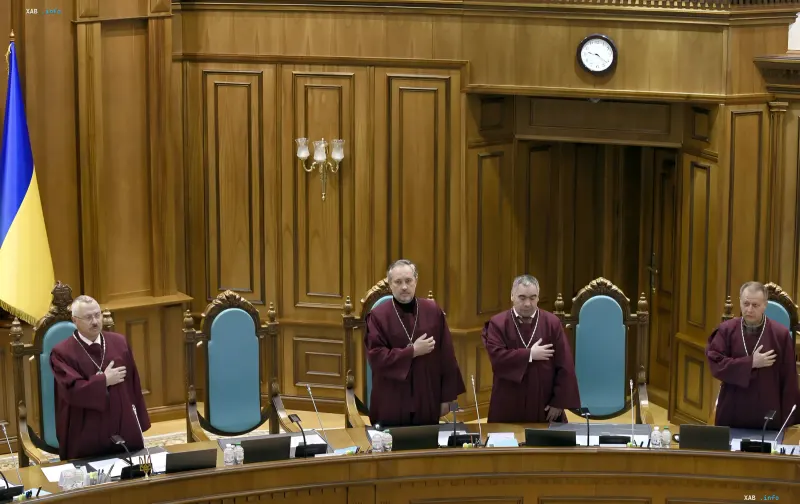
The Second Senate of the Constitutional Court of Ukraine reviewed the constitutional complaint of Volodymyr Treizub and recognized as compliant with the Basic Law the provision allowing parole for persons convicted of severe corruption offenses after serving two-thirds of their designated sentence. This was reported by RBC-Ukraine with reference to the Constitutional Court. At the same time, the courts established that in the applicant's specific case, the Chernihiv Court of Appeal applied the contested provision in a manner inconsistent with the Constitution of Ukraine.
Essence of the Dispute: Practice That Made Parole Practically Impossible
The constitutional complaint concerned the judicial practice of applying paragraph 2 of part three of Article 81 of the Criminal Code of Ukraine to individuals convicted of severe corruption crimes. According to the applicant, the courts interpreted this provision in such a way that early release of convicts became practically impossible even after serving two-thirds of the assigned term. The court of first instance, conversely, concluded that Volodymyr Treizub could be conditionally released from punishment, but the Chernihiv Court of Appeal subsequently canceled this decision and denied the application of parole.
CCU Decision: The Provision is Constitutional, but Applied Incorrectly
Having examined the issues raised in the complaint, the Second Senate of the CCU concluded that the current rules of serving two-thirds of the sentence for severe corruption crimes comply with the Constitution of Ukraine. Simultaneously, the court established that the Chernihiv Court of Appeal applied the contested provision in the applicant's case in a way that does not correspond to the Basic Law. Thus, the CCU separated the assessment of the norm itself (constitutional) from the assessment of its application in a specific case (unlawful interpretation).
Official Text of the Decision to Be Published on November 19
The official text of the adopted decision No. 15-r(II)/2026 and its summary will be published on the website of the Constitutional Court of Ukraine on November 19, 2026. Until the full text is published, the details of the legal reasoning behind the court's position remain restricted, while key conclusions are known from the press service statement of the CCU.
Context: Series of CCU Decisions on the Rights of Convicts
The decision in the Treizub case fits into a series of important rulings by the Constitutional Court regarding the rights of convicts and suspects. In late October 2026, the CCU clarified the rules for the mobilization of individuals convicted of murder, refusing to introduce parole for accomplices in exchange for their military service. In the summer of this year, the court abolished mandatory arrest for military personnel suspected of crimes during martial law, recognizing as unconstitutional the provision that automatically detained such servicemen without the option of choosing a milder preventive measure.