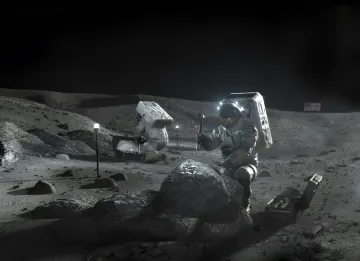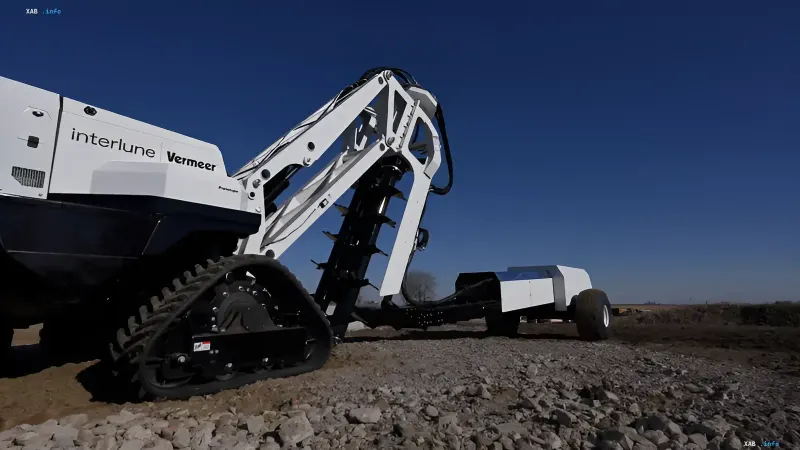
American space company Interlune and renowned heavy equipment manufacturer Vermeer have entered a new phase of collaboration. The companies intend to move from creating single prototypes to mass production of robotic platforms designed for construction work on the lunar surface. Key equipment for future lunar rovers is planned to be sent to Earth's moon as early as 2028.
From helium mining to infrastructure construction
Initially, the excavator project was developed as part of a system for mining the valuable isotope helium-3. The process involved four stages: soil excavation, sorting, volatile extraction, and gas separation. However, plans have changed. According to NASA's new concept, the priority has become the accelerated creation of permanent presence bases. This required a reorientation of the machinery: it must now become a tool for building infrastructure.
The first unit will perform tasks such as site grading, removal of large rocks, and regolith compaction. A large rotating milling drum—similar to equipment widely used in terrestrial construction—has been selected as the main working organ. Its task is to cut the top layer of lunar soil, smooth out irregularities, and prepare foundations for roads, landing pads, and living modules.
Engineering challenges of low gravity
One of the main problems in designing lunar machinery is physics. Earth-moving machines on our planet use their own mass to generate force when acting on rock. On the Moon, gravity is six times weaker, so conventional methods do not work. To solve this problem, Interlune, in collaboration with the Colorado School of Mines, is developing physical models.
Specialists are calculating the tool penetration force, optimal angle of attack, productivity, and energy consumption. Special attention is paid to the wear rate of equipment under the influence of extremely abrasive lunar dust. Tests on a regolith simulator are also aimed at identifying the risks of mechanism jamming.
Technical specifications and the future of the project
The project is based on a full-scale continuous soil excavation unit presented in 2025. The prototype is designed to process up to 100 metric tons of regolith per hour, returning the processed material to the surface in a continuous stream. Thanks to a design adapted to lunar conditions, the machinery consumes less energy and raises less dust compared to traditional bucket and trenching machines.
In the future, functionality expansion is planned: creating trenchers for laying cables and pipelines, as well as equipment for building protective berms around power plants. A demonstration complex is planned to be installed on a lunar rover and sent to the Moon around 2028–2029, laying the foundation for an American base.