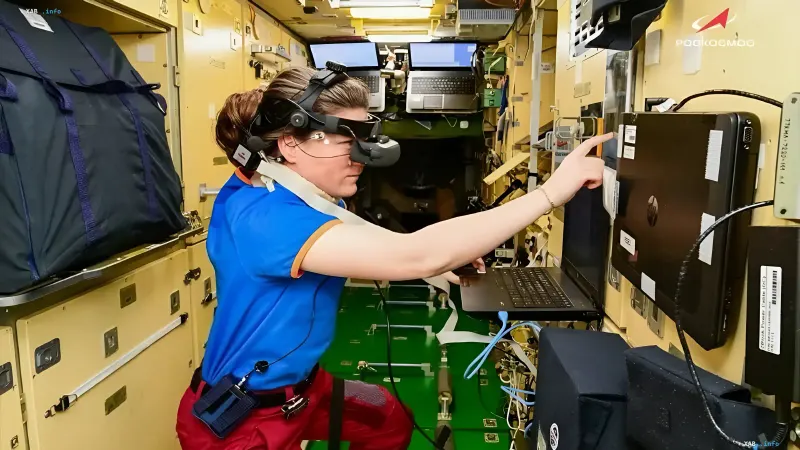
Russian cosmonauts aboard the International Space Station have completed a series of research sessions as part of the scientific experiment «Virtual». This space program is designed to study in detail the complex mechanisms of human body adaptation to long-term orbital flight conditions, as well as to identify the features of interaction between the visual and vestibular systems in the absence of gravity.
Essence and methodology of the «Virtual» experiment
In space flight conditions, familiar landmarks disappear, leading to severe disorientation and the so-called «space motion sickness». To understand exactly how the brain processes conflicting signals, cosmonauts use specialized VR goggles. During the tests, a crew member must visually track the movement of a small target on a virtual screen moving along various trajectories.
Technical details and data recording
The target on the screen can move smoothly or abruptly, sometimes accompanied by additional visual interference to complicate the task. Sensors built into the device and helmet record the slightest micro-movements of the eyes, allowing scientists on Earth to assess the degree of fatigue and visual tracking features. The collection of biometric information is carried out cyclically: before the flight, directly during the stay in orbit, and upon return to Earth.
Significance of the study for future missions
The data obtained during the «Virtual» experiment are of critical importance for planning future interplanetary expeditions and long-term manned flights. Based on the collected telemetry, experts will be able to significantly improve ground training programs for cosmonauts and develop new methods for preventing vestibular disorders in zero gravity.