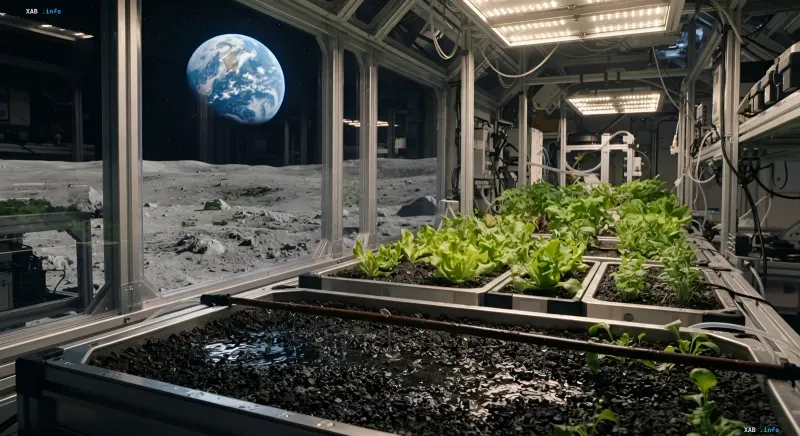
Creating autonomous life-support systems for future lunar bases faces fundamental physical obstacles, the primary being the reliable irrigation of plants. Researchers led by space biologist John Kiss, Carl Hasenstein, and Christopher McKay examined fluid behavior under lunar gravity conditions. They found that weak gravity drastically increases the role of surface tension, altering the entire dynamics of water movement within containers and porous materials.
The Role of Lunar Gravity and the New Shepard Experiment
Lunar gravity is approximately one-sixth of Earth's, causing gravity to lose its dominance in moisture distribution. During the suborbital flight of Blue Origin's New Shepard 29 in February 2025, scientists tested three liquids: pure water, a saline solution, and a 30% glycerin solution. Under two minutes of simulated lunar gravity, researchers observed significant changes in the meniscus and fluid motion, confirming theoretical concerns.
The Lunar Regolith Challenge and Special Additives
An additional challenge is lunar regolith—fine-grained fragmented rock differing greatly from terrestrial soil in structure and porosity. The combination of weak gravity and regolith properties affects moisture distribution and oxygen delivery to roots. The 30% glycerin solution demonstrated more favorable flow characteristics, leading scientists to consider special additives as a viable way to manage water behavior in space farming.
Research Prospects and Significance for Future Missions
Growing crops like potatoes is viewed as a key element for supplying crews with food, oxygen, and water, as well as waste recycling. Researchers plan to continue experiments with longer lunar gravity simulations and eventually conduct direct tests on the Moon's surface. These findings will form the basis for designing entirely new irrigation systems adapted for space realities.