Amidst the rapidly growing demands on artificial intelligence infrastructure, DapuStor has announced a major update to its portfolio of enterprise storage devices. Against the backdrop of a global shortage of high-performance data storage solutions, the manufacturer has introduced devices capable of handling exabyte-scale data arrays. The highlight of the presentation was the industry's first solid-state drives (SSDs) with a capacity of 512TB, developed specifically for generative AI and high-performance computing tasks.
R6060 Series: A Breakthrough in Storage Density
The flagship product of the new lineup is the R6060 series. These drives, based on QLC (Quad-Level Cell) flash memory chips, offer unprecedented write density. The use of the PCIe 5.0 interface ensures the necessary throughput for working with massive volumes of data. DapuStor positions these devices as a solution for reducing the total cost of ownership (TCO) of data centers: increasing the capacity of a single module allows for a reduction in the number of physical drives, which directly impacts power consumption and the space occupied in server racks.
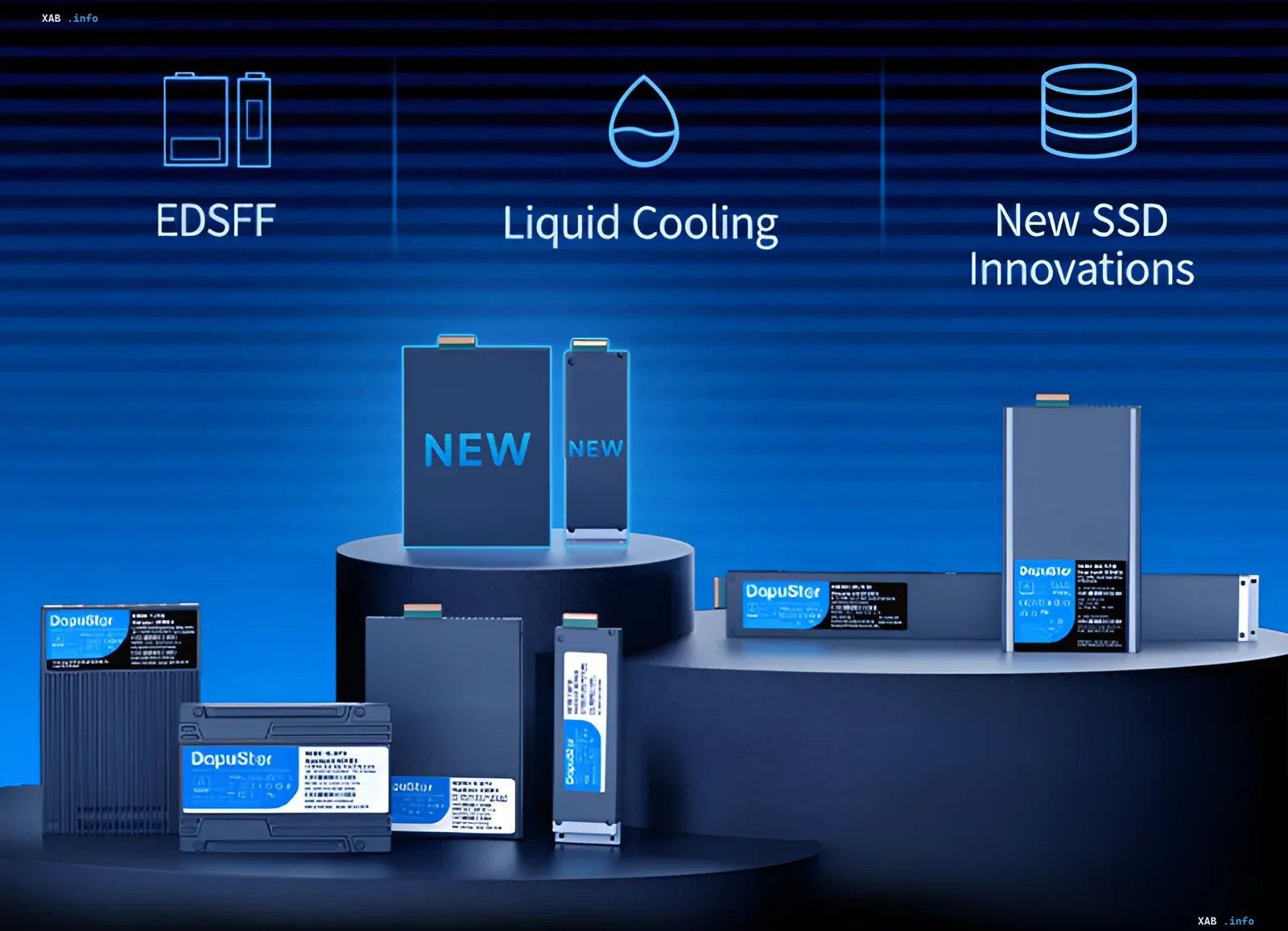
It is important to note that the R6060 series drives are released in next-generation EDSFF (Enterprise and Data Center SSD Form Factor) form factors — E3.L and E2. This standard is designed to replace outdated 2.5-inch disk and U.2 form factors, offering more efficient cooling and better mounting density.
Liquid Cooling and Specialized Solutions
For tasks requiring maximum equipment density, DapuStor introduced the R6 drive in the E1.S form factor with a capacity of 8TB. The main feature of this device is its liquid cooling system. Unlike traditional air cooling, which becomes a bottleneck in the dense configuration of servers with a large number of GPUs, the liquid system allows for effective heat dissipation, maintaining high performance of TLC (Triple-Level Cell) chips even during prolonged peak loads.
Additionally, the company expanded flexible storage architecture capabilities with the J5060 series based on QLC memory. These drives are designed for use in tiered storage systems, where they complement ultra-fast SLC drives. This configuration allows AI systems to simultaneously utilize high-speed access to "hot" data and massive capacity for "cold" archives.
Reliability and New Form Factors
The new lineup also includes dual-port SSDs from the R6 family in the E3.S form factor. The presence of two ports is critical for corporate systems where the failure of one communication channel should not lead to loss of data access. These devices are available in two configurations: a TLC version with a capacity of up to 30.72TB and a QLC version offering up to 61.44TB. This solution is ideal for cluster systems where high reliability and a balance between speed and volume are required.
Conflicting Data
An analysis of the stated specifications and industry reviews has revealed some discrepancies in the figures regarding the capacity of the flagship models. In official press releases regarding the presentation at FMS2026, DapuStor claims the debut of drives with a capacity of 512TB. However, in some technical reviews and specifications related to the R6060 series in the E1.L format, models with a capacity of 245.76TB are mentioned. Experts suggest that 512TB may be the maximum theoretical capacity for the E3.L form factor, while 245.76TB is the current commercial standard for the more compact E1.L form factors. Buyers are advised to clarify specific specifications when ordering equipment, as differences in form factors significantly affect the final capacity.