The search for dark matter is like looking for lost keys at night under a streetlamp: where it is light, not where they actually fell. Scientists have long been analyzing data from the Large Hadron Collider (LHC), hoping to find traces of this elusive substance. However, a new hypothesis suggests looking at the problem from a different angle — through the lens of mysterious malfunctions in the accelerator itself.
Mysterious 'UFOs' in the Vacuum Tube
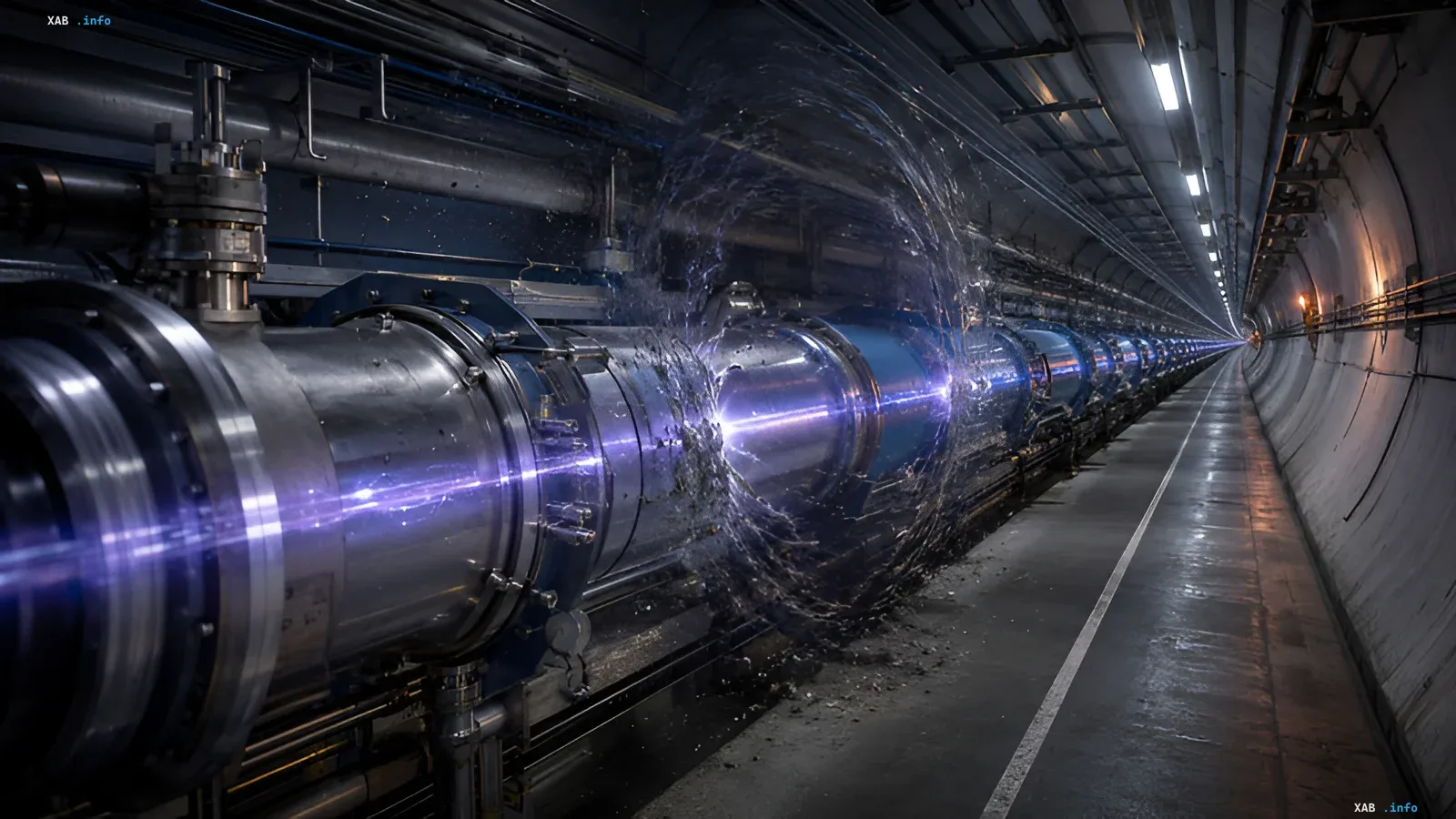
Periodically, anomalies are recorded in the LHC's operation, which physicists call UFOs. This has nothing to do with flying saucers. The acronym stands for Unidentified Falling Objects. It refers to microscopic dust particles that suddenly appear in the collider's vacuum tube.
These particles behave extremely strangely: they seem to shake out of the accelerator walls, although this requires significant energy that cannot appear out of nowhere. When such dust particles hit the proton beam, they cause its disruption, which is instantly recorded by sensors. All this information is stored in CERN archives and could now become the subject of new research.
Hypothesis by Physicists from British Columbia
Two scientists — physicists Xunyu Liang and Ariel Zhitnitsky from the University of British Columbia — latched onto this anomaly. They hypothesized that some of the mysterious malfunctions could be indirectly related to dark matter.
Initially, the researchers considered the possibility that the dust particles are clumps of axion quark nuggets (AQN) — a hypothetical substance that arose immediately after the Big Bang. However, the size of the observed particles (microns) did not match the theoretical mass estimates of AQN, which should range from 100 grams to 1 kilogram.
Underground Acoustic Wave
Then the scientists revised the model. They calculated that kilogram-sized AQN clumps, flying through the Earth within a distance of no more than 100 km from the collider ring, could generate a powerful underground acoustic wave. The energy of this wave should be enough to literally "shake" the equipment and dislodge dust from the accelerator walls.
The main sign of such an event would not be a single beam loss, but a series of three or more malfunctions at different sections of the 27-kilometer ring. The shock wave, propagating through the rock at a speed of about 4 km/s, should sequentially affect the equipment. Linked signals should appear with intervals ranging from 6 milliseconds to 2 seconds.
How to Confirm the Theory?
To test the hypothesis, existing infrastructure is sufficient. About 4,000 beam loss monitors installed along the collider are capable of registering such signals. The results can be additionally correlated with data from CERN's seismic network, distributed acoustic sensors, and infrasound stations.
The authors of the study estimate that AQN could cause between 1% and 10% of the observed UFOs. Over 360 hours of operation, a series of three linked events would create a signal five times higher than the noise level across the entire mass range considered.
At present, this is only a theoretical prediction. Its confirmation will require a re-analysis of archival data and the detection of a space-time correlation that cannot be explained by ordinary dust or mechanical interference. The work does not include such an analysis but recommends that interested scientific groups take up this task.