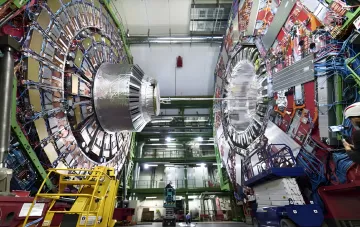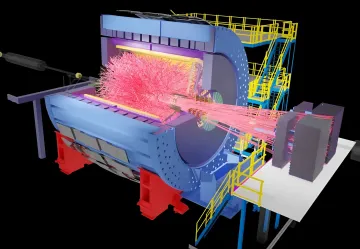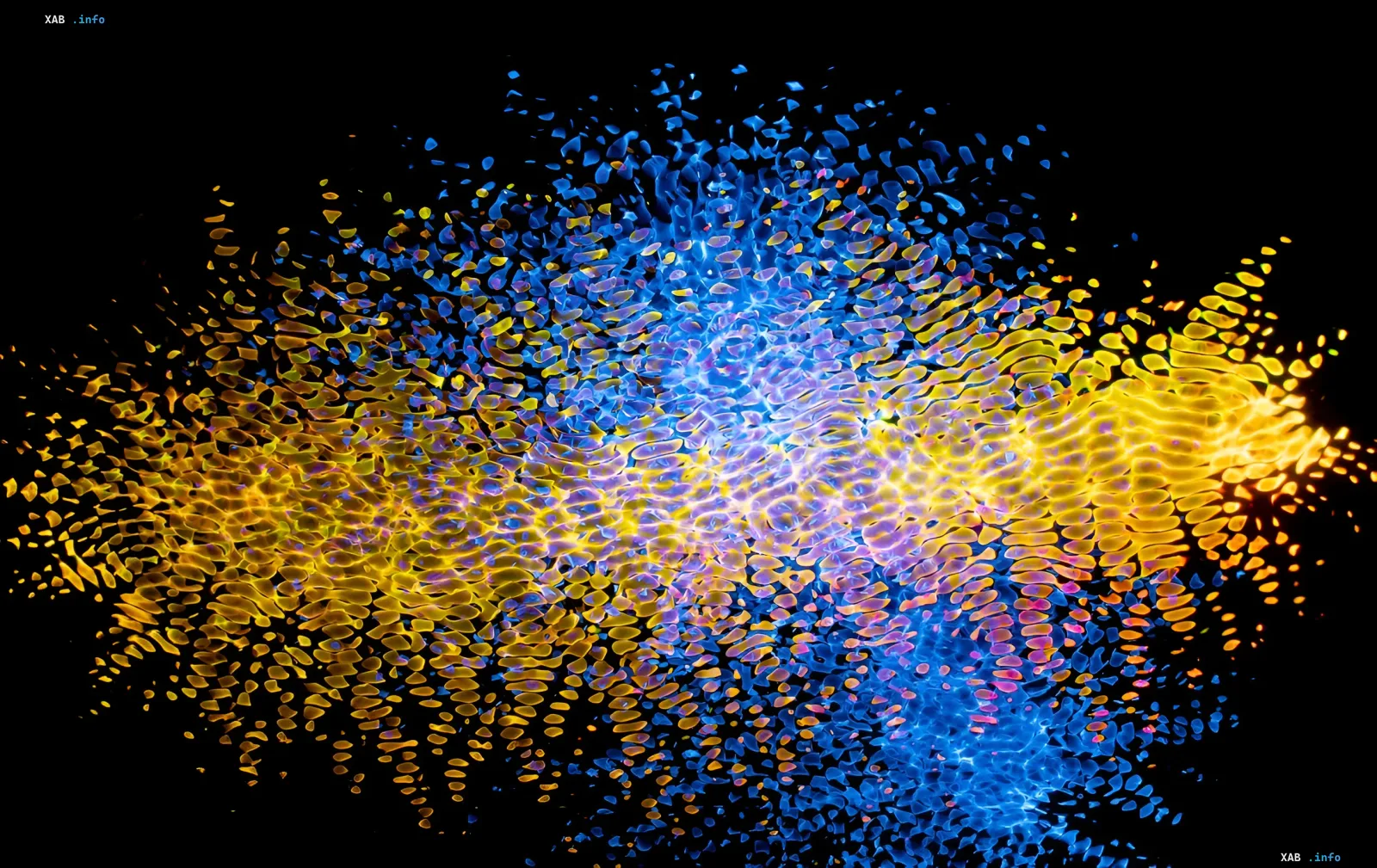
Within the walls of CERN, an event has occurred that can be compared to launching a time machine. Scientists have managed to recreate the conditions that prevailed in the first microseconds after the Big Bang. Experiments have confirmed the formation of quark-gluon plasma — a state of matter considered to be the 'primordial substance' of our Universe.
Temperature 100,000 Times Higher than the Sun
Quark-gluon plasma (QGP) is not just hot gas. It is an extreme state arising under monstrous pressure and temperatures that are more than 100,000 times higher than the heat at the center of the Sun. Under such conditions, familiar complex particles cannot withstand the stress and break down into their fundamental constituents — quarks and gluons.
Almost 14 billion years after the emergence of the Universe, physicists managed to briefly recreate this ancient world using high-energy nuclear collisions in the Large Hadron Collider (LHC).
Breaking Old Theories: Light Nuclei vs. Heavy Nuclei
For a long time, the scientific community was dominated by the opinion that the birth of such an extreme environment required collisions of exclusively heavy ions. It was believed that only lead nuclei, which are more than 200 times heavier than protons, were capable of creating sufficient volume and density for plasma formation.
However, new experimental data refuted this dogma. Research has proven: to create the primordial medium, the mass of lighter atomic nuclei is sufficient. Collisions of oxygen and neon nuclei in the collider revealed clear signs of quark-gluon plasma formation.
The 'Jet Quenching' Effect as the Main Proof
How did scientists realize that plasma had formed? The main confirmation was the loss of energy by fast quarks and gluons as they passed through the hot medium. This phenomenon is called 'jet quenching'.
The ATLAS collaboration recorded this effect by paying attention to the imbalance of partial jet pairs. In head-on collisions with a large volume of plasma, the energy of particles was quenched, which became a marker of the presence of QGP.
The CMS and LHCb detectors confirmed these observations, recording the suppression of the birth of energetic particles. Notably, in neon-neon systems, this suppression turned out to be even stronger than expected due to the large size of the formed plasma volume.
Matter Behaving as a Single Flow
In addition to energy loss, the ALICE detector recorded another fundamental feature. Particles arising after the collision did not move chaotically, as happens in an ordinary gas, but in a coordinated manner, as if captured by a common flow.
This indicates that quark-gluon plasma does not behave as a set of separate scattered particles, but as a single rare substance with unique properties. These discoveries open new horizons in understanding how matter was formed at the very beginning of the existence of our Universe.