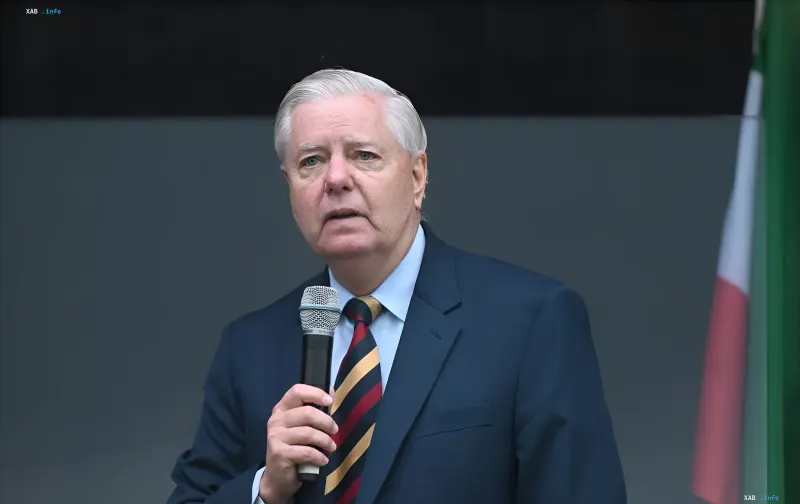
On July 11, the world was shaken by the news of the death of American Senator Lindsey Graham. The politician passed away literally a day after his visit to Kyiv, which coincided with his birthday. This final trip to the Ukrainian capital became a symbol of his long-standing position: Graham was one of the most consistent supporters of military aid to Kyiv in the US Congress.
From Military Lawyer to Senate Leader
Lindsey Graham's path to the highest levels of power began in the state of South Carolina. Raised in a family of entrepreneurs, he received an education in psychology and law, after which he followed the path of military service. In the US Air Force, he worked as a military lawyer and later headed the Air Force prosecution in Europe. His combat record included service in the Persian Gulf, as well as in Iraq and Afghanistan, where he was awarded the "Bronze Star" for meritorious service.
Graham's political career began in 1992. He rose from the State House of Representatives to the national level, and in 2002 was first elected to the US Senate. He held this position for more than 20 years, being regularly re-elected and accumulating colossal influence.
Architect of the Judicial System and Master of Compromise
Graham's domestic influence is hard to overestimate. As chairman of the Judiciary Committee, he played a decisive role in the appointment of conservative judges to the US Supreme Court, which became one of the main victories of the Republicans in recent decades. Despite his image as a conservative, Graham was famous for his ability to find compromises with Democrats, joining forces with them for reforms in the areas of immigration, military justice, and gun control.
However, in matters of foreign policy, the senator proved himself to be a convinced "hawk." Together with John McCain, he harshly criticized Russia, advocated for the expansion of NATO, and called for a decisive US military presence in the world.
Support for Ukraine and a Complex Friendship with Trump
It was precisely due to his position on security issues that Graham became one of Ukraine's main allies in Washington. He systematically voted for military aid, called for the delivery of fighter jets and long-range weapons. In 2022, with his participation, the Senate approved a resolution recognizing Russia as a state sponsor of terrorism.
Graham's relationship with Donald Trump was not simple. If in 2016 the senator harshly criticized the future president, over time he became his trusted advisor. This was reflected in his position on Ukraine: after the scandalous meeting between Zelenskyy and Trump in February of last year, Graham publicly stated that Zelenskyy needed to "either resign or change." However, when the relationship between the leaders normalized, the senator returned to the line of supporting Kyiv.
The Fate of the Graham-Blumenthal Bill
The main unfinished business of the senator in the context of the Ukrainian issue remains the Graham-Blumenthal bill. A joint initiative with Democrat Roger Blumenthal provides for the introduction of strict trade tariffs against Russia to force the Kremlin to peace. The project was registered as early as last year, but required the approval of the White House, which Trump did not give for a long time.
At a briefing in Kyiv, Graham stated that he had reached an agreement with the administration on an updated version of the law. His death does not mean the end of this initiative: many fellow senators have already declared their intention to continue working on the adoption of the bill that Graham defended for so long.