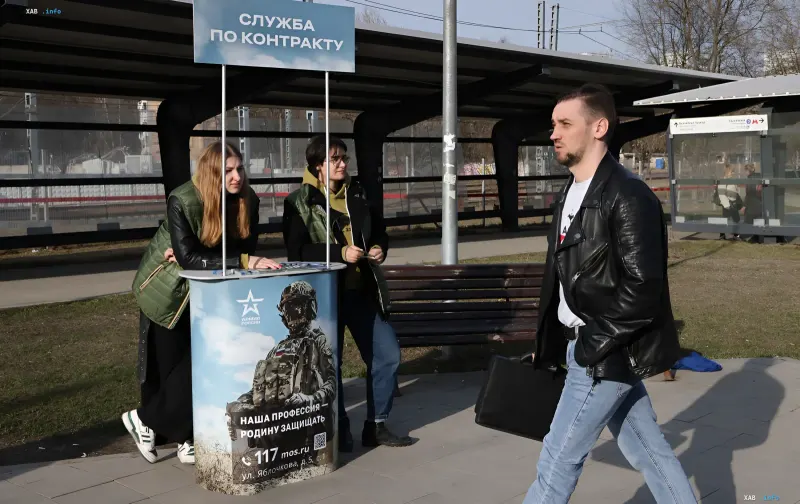
The pace of contract recruitment into the Russian army in 2026 continues to decline, even as regions repeatedly raise the one-time payments for signing a contract. According to calculations by Janis Kluge, a research fellow at Germany's Institute for International Security, who relied on regional budget data, around 234,000 people signed contracts with the Russian Ministry of Defense between January and August 2026. That is roughly 26,000 fewer than in the same period of 2025, with recruitment rates falling by 10%. The data is cited by RBC-Ukraine with reference to The Moscow Times.
The August Dip and Record Payments
The drop was especially pronounced in August: according to the researcher's estimate, the decline in that month reached 20%. The paradox is that it was precisely against this backdrop that the average one-time payment for signing a new contract in Russian regions hit a record high of nearly 1.8 million rubles. Volgograd Oblast remains the leader in generosity, where the maximum one-time payment stands at 3.4 million rubles. Nevertheless, financial incentives are no longer sufficient to sustain the previous pace of recruitment, indicating that the "easy" reserves of recruitment have been exhausted.
Budgetary Pressure: What Regions Are Cutting
To meet the recruitment quotas set by the Kremlin, Russian regions are forced to cut spending on civilian needs. The authorities of Yakutia, in particular, announced a postponement of salary indexation for budget-sector workers, citing "unforeseen expenses" linked to recruiting people for the war. The governor of Volgograd Oblast, Andrey Bocharov, scrapped the annual youth festival, citing the need to save funds for "supporting the defenders of the Fatherland." By the end of last year, the combined deficit of Russian regional budgets reached a record 1.5 trillion rubles in history, and according to a forecast by Sberbank's Center for Macroeconomic Research, the deficit could rise to 2 trillion rubles in 2026.
Contradictory Data
When comparing figures from different sources and regions, discrepancies emerge in the scale of payments, which is important to keep in mind when interpreting the data. The federal summary refers to an average one-time payment of around 1.8 million rubles and a regional maximum of 3.4 million rubles (Volgograd Oblast). At the same time, certain regional publications, for example from Krasnodar Krai, cite amounts of up to 6 million rubles per year — but this is already an indicator of total annual compensation, not a one-time payment upon signing a contract. Thus, the discrepancy is explained by different calculation methods (one-time payment versus annual income) and differing regional policies, rather than by any contradiction in the assessment of overall recruitment rates, which, according to Kluge's data, are steadily declining.
How Many Actually Join the Army
Despite the slowing pace, the Russian army is still managing to attract around 1,000 new soldiers per day, Kluge notes. This figure, while below last year's, remains higher than the 2024 level: according to the researcher's calculations, by the beginning of September 2024, fewer than 200,000 people had signed contracts with the Russian Ministry of Defense. Meanwhile, according to GUR (Main Intelligence Directorate) data, generals appealed to Vladimir Putin with a request to provide an additional 800,000 military personnel. GUR head Oleksandr Ivashchenko emphasizes that the figure voiced by the generals significantly exceeds the real capabilities of the Russian army.
Context: Departures and Mobilization Documents
Against the backdrop of slowing voluntary recruitment in Russia, restrictions on the departure of reservist military-age men from the country are being tightened in parallel. The first case has been recorded in which a reservist was not allowed to leave the country due to a mobilization order in his documents. The combination of these measures — from record payments and regional savings to border controls — indicates that Moscow is increasingly relying on coercive and administrative recruitment tools amid declining interest in contract service.